MCQ
A particle is moving with uniform speed along the circumference of a circle of radius $R$ under the action of a central fictitious force $F$ which is inversely proportional to $R ^{3}$. Its time period of revolution will be given by
  • $T \propto R ^{2}$
  • B
    $T \propto R ^{\frac{3}{2}}$
  • C
    $T \propto R ^{\frac{5}{2}}$
  • D
    $T \propto R ^{\frac{4}{3}}$

Answer

Correct option: A.
$T \propto R ^{2}$
a
$F \propto \frac{1}{R^{3}}$

$\frac{K}{R^{3}}=m \omega^{2} R$

$\omega^{2}=\frac{K}{m} \times \frac{1}{R^{4}}$

$\left(\frac{2 \pi}{T}\right)^{2}=\frac{K}{m} \times \frac{1}{R^{4}}$

$T^{2} \propto R^{4}$

$T \propto R^{2}$

Need a full question paper?

Generate a complete, print-ready paper with questions like this in minutes — across 16+ boards, with answer keys.

Start Generating Free

Similar questions

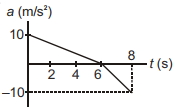
The acceleration-time graph for a particle moving along $x$-axis is shown in figure. If the initial velocity of particle is $-5 \,m / s$, the velocity at $t=8 \,s$ is ....... $m / s$
A point object is kept in front of a plane mirror. The plane mirror is doing $SHM$ of amplitude $2\,cm$. The plane mirror moves along the $x-$ axis and $x-$ axis is normal to the mirror. The amplitude of the mirror is such that the object is always infront of the mirror. The amplitude of $SHM$ of the image is .... $cm$
A planet moves around the sun. At a given point $P$, it is closest from the sun at a distance ${d_1}$ and has a speed ${v_1}$. At another point $ Q$, when it is farthest from the sun at a distance ${d_2}$, its speed will be
The Young's modulus of a rubber string $8\, cm$ long and density $1.5\,kg/{m^3}$ is $5 \times {10^8}\,N/{m^2}$, is suspended on the ceiling in a room. The increase in length due to its own weight will be
A wheel initially at rest, is rotated with a uniform angular acceleration. The wheel rotates through an angle ${\theta _1}$ in first one second and through an additional angle ${\theta _2}$ in the next one second. The ratio $\frac{{{\theta _2}}}{{{\theta _1}}}$ is
If the dimensions of length are expressed as ${G^x}{c^y}{h^z}$; where $G,\,c$ and $h$ are the universal gravitational constant, speed of light and Planck's constant respectively, then
An aeroplane is flying at a constant horizontal velocity of $600\, km/hr $ at an elevation of $6\, km$ towards a point directly above the target on the earth's surface. At an appropriate time, the pilot releases a ball so that it strikes the target at the earth. The ball will appear to be falling
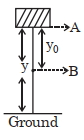
In the given figure, the block of mass $m$ is dropped from the point ' $A$ '. The expression for kinetic energy of block when it reaches point ' $B$ ' is ................
Two particles are executing $SHM$ in a straight line. Amplitude $'A'$ and time period $'T'$ of both the particles are equal. At time $t = 0$ one particle is at displacement $x_1 = +A$ and other at ${x_2} = \frac{{ - A}}{2}$ and they are approaching towards each other. Time after which they will cross each other is
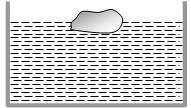
A body floats in a liquid contained in a beaker. The whole system as shown falls freely under gravity. The upthrust on the body due to the liquid is