Question
A particle is observed from two frames S1 and. S2. The frame Smoves with respect to Swith an acceleration a. Let F1 and F2 be the pseudo forces on the particle when seen from S1 and S2 respectively. Which of the following are not possible?
  1. F1 = 0, F2 ≠ 0
  2. F1 ≠ 0, F2 = 0
  3. F1 ≠ 0, F2 ≠ 0
  4. F= 0, F= 0

Answer

  1. F= 0, F= 0

Explanation:

$\text{a}_{\text{s}_1\text{s}_2}=\text{a} \ ...(1) $

Acceleration of the particle w.r.t. to $\text{S}_1=\frac{\text{F}_1}{\text{m}}$

Acceleration of the particle w.r.t. to $\text{S}_2=\frac{\text{F}_2}{\text{m}}$

If we assume F1 = 0 and F2 = 0,

we can conclude that $\text{a}_{\text{s}_2\text{s}_1}=0 \ ...(2)$

From equations (1) and (2), we can say that our assumption is wrong.

And F1 = 0, F2 = 0 is not possible.

Need a full question paper?

Generate a complete, print-ready paper with questions like this in minutes — across 16+ boards, with answer keys.

Start Generating Free

Similar questions

A double convex lens has focal length 25cm. The radius of curvature of one of the surfaces is double of the other. Find the radii, if the refractive index of the material of the lens is 1.5.
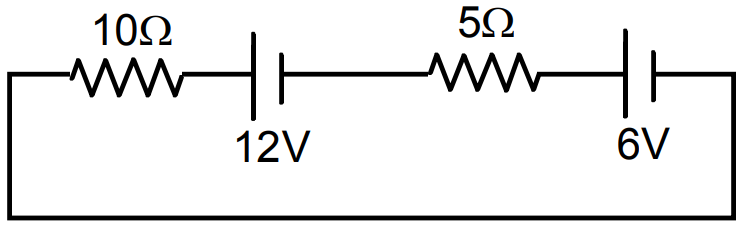
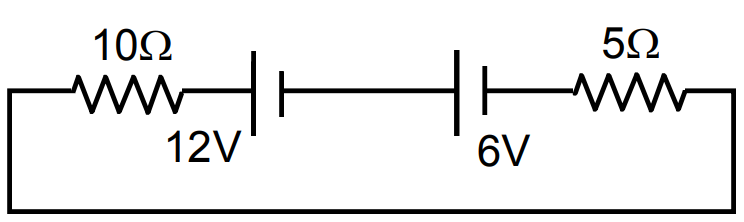
Consider the circuit shown in the figure. Find (a) the current in the circuit (b) the potential drop across the $5\Omega$ resistor (c) the potential drop across the $10\Omega$ resistor. (d) Answer the parts (a), (b) and (c) with reference to the figure.


A uniform magnetic field B exist in a region. An electron projected perpendicular to the field goes in a circle. Assuming Bohr's quantization rule for angular momentum, calculate (a) the smallest possible radius of the electron (b) the radius of the nth orbit and (c) the minimum possible speed of the electron.
Derive the expression for the magnetic field at the site of a point nucleus in a hydrogen atom due to the circular motion of the electron. Assume that the atom is in its ground state and give the answer in terms of fundamental constants.
What is the speed of a photon with respect to another photon if:
  1. The two photons are going in the same direction and.
  2. They are going in opposite directions?
We have stimulated emission and spontaneous emission. Do we also have stimulated absorption and spontaneous absorption?
A capacitor having a capacitance of $100\mu\text{F}$ is charged to a potential difference of 50V.
  1. What is the magnitude of the charge on each plate?
  2. The charging battery is disconnected and a dielectric of dielectric constant 2.5 is inserted. Calculate the new potential difference between the plates.
  3. What charge would have produced this potential difference in absence of the dielectric slab.
  4. Find the charge induced at a surface of the dielectric slab.
The wavelengths of $\text{K}_\alpha$ and $\text{L}_\alpha$ X-rays of a material are 21.3pm and 141pm respectively. Find the wavelength of $\text{K}_\beta$ X-ray of the material.
Define electric dipole moment. Calculate the value of electric potential generated from electric dipole and prove that its value is maximum at the point situated on the axis and zero at the equatorial point? ###Define electric dipole moment of electric dipole. Obtain an expression for the electric potential at a common point due to electric dipole. Also draw necessary diagram.
Consider a wire of length 4m and cross-sectional area 1mm2 carrying a current of 2A. If each cubic metre of the material contains 1029 free electrons, find the average time taken by an electron to cross the length of the wire.