Question
A particle is observed from two frames S1 and. S2. The frame Smoves with respect to Swith an acceleration a. Let F1 and F2 be the pseudo forces on the particle when seen from S1 and S2 respectively. Which of the following are not possible?
  1. F1 = 0, F2 ≠ 0
  2. F1 ≠ 0, F2 = 0
  3. F1 ≠ 0, F2 ≠ 0
  4. F= 0, F= 0

Answer

  1. F= 0, F= 0

Explanation:

$\text{a}_{\text{s}_1\text{s}_2}=\text{a} \ ...(1) $

Acceleration of the particle w.r.t. to $\text{S}_1=\frac{\text{F}_1}{\text{m}}$

Acceleration of the particle w.r.t. to $\text{S}_2=\frac{\text{F}_2}{\text{m}}$

If we assume F1 = 0 and F2 = 0,

we can conclude that $\text{a}_{\text{s}_2\text{s}_1}=0 \ ...(2)$

From equations (1) and (2), we can say that our assumption is wrong.

And F1 = 0, F2 = 0 is not possible.

Need a full question paper?

Generate a complete, print-ready paper with questions like this in minutes — across 16+ boards, with answer keys.

Start Generating Free

Similar questions

The Mean Free Path $\ell$ for a gas molecule depends upon diameter, $d$ of the molecule as
The driver of a car travelling with speed $30$ metres per second towards a hill sounds a horn of frequency $600 Hz$. If the velocity of sound in air is $330$ metres per second, the frequency of the reflected sound as heard by the driver is  .... $Hz$
One solid sphere $A$ and another hollow sphere $B$ are of same mass and same outer radii. Their moment of inertia about their diameters are respectively $I_{A}$ and $I_{B}$ such that Where $d_{A}$ and $d_{B}$ are their densities
If a car at rest accelerates uniformly to a speed of 144km/ h in 20s, it covers a distance of:
The r.m.s. velocity of a gas is:
The phase difference between two $SHM\,\,$  ${y_1}\, = \,10\,\sin \,\left( {10\pi t\, + \,\frac{\pi }{3}} \right)$ and ${y_2}\, = \,12\,\sin \,\left( {8\pi t\, + \,\frac{\pi }{4}} \right)$  at $t = 0.5\,s$ it
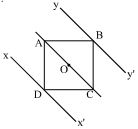
Let $I_1, I_2$ and $I_3$ be the moment of inertia of a uniform square plate about axes $AOC, xDx'$ and $yBy'$ respectively as shown in the figure. The moments of inertia of the plate $I_1 : I_2 : I_3$ are in the ratio.
Which one of the following statements regarding artificial satellite of the earth is incorrect
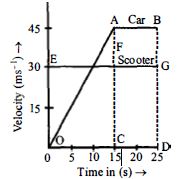
The velocity-time graphs of a car and a scooter are shown in the figure. $(i)$ the difference between the distance travelled by the car and the scooter in $15\, s$ and $(ii)$ the time at which the car will catch up with the scooter are, respectively
A boy throws a ball with a velocity $u$ at an angle $\theta$ with the horizontal. At the same instant he starts running with uniform velocity to catch the ball before if hits the ground. To achieve this he should run with a velocity of