MCQ
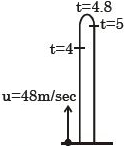
A particle is projected from ground in vertical upward direction at $t = 0$, with initial velocity $48\, m/s$ and the distance travelled by particle in $5^{th}$ second is......$m$ $(g = 10\, m/s^2)$
  • A
    $3$
  • B
    $115$
  • $3.4$
  • D
    $2.8$

Answer

Correct option: C.
$3.4$
c
$5^{\text {th }}$ sec $\Rightarrow t=4 \rightarrow t=5$

$\mathrm{S}_{4 \rightarrow 8}=$ Displacement in last $0.8\, sec$ of upward journey

$\mathrm{S}=\mathrm{vt}-\frac{1}{2} \mathrm{a}_{\mathrm{y}} \mathrm{t}^{2}, \mathrm{v}=0$

Assuming upward direction to be positive $(+i v e)$

$a_y=-g$

$S_{4 \rightarrow 4.8}=\frac{1}{2} \times g \times(0.8)^{2}=5 \times 0.64$

$\begin{aligned} \mathrm{S}_{4.8 \rightarrow 5}=& \mathrm{ut}+\frac{1}{2} \mathrm{at}^{2} \\ &=0+\frac{1}{2} \times 10 \times(0.2)^{2}=5 \times 0.04 \end{aligned}$

$\mathrm{S}_{4 \rightarrow 5}=5 \times 0.68=\frac{17}{5} \mathrm{m}$
Need a full question paper?

Generate a complete, print-ready paper with questions like this in minutes — across 16+ boards, with answer keys.
Start Generating Free

Similar questions

The quantity of heat which crosses unit area of a metal plate during conduction depends upon
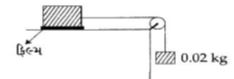
A metal block of base area $0.2\; m ^{2}$ is connected to a $0.02\; kg$ mass via a string that passes over an ideal pulley as shown in figure. A liquid film of thickness $0.6\; mm$ is placed between the block and the table. When released the block moves to the right with a constant speed of $0.17\; m / s$. The co-efficient of viscosity of the liquid is
Calculate the velocity of a body of a mass $2\ kg$ whose linear momentum is $5N$ s.
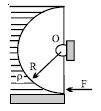
A light semi cylindrical gate of radius $R$ is piovted at its mid point $O$, of the diameter as shown in the figure holding liquid of density $\rho $. The force $F$ required to prevent the rotation of the gate is equal to 
A black body at $1227^o C$ emits radiations with maximum intensity at a wavelength of $5000\;\mathring A$ . If the temperature of the body is increased by $1000^o C$, the maximum intensity will be observed at ...... $\mathring A$
$Assertion$ : When percentage errors in the measurement of mass and velocity are $1\%$ and $2\%$ respectively, the percentage error in $K.E.$ is $5\%$.

$Reason$ : $\frac{{\Delta E}}{E} = \frac{{\Delta m}}{m} + \frac{{2\Delta v}}{v}$

A solid cube and a solid sphere of identical material and equal masses are heated to the same temperature and left to cool in the same surroundings. Then,
Velocity of a particle moving in a curvilinear path in a horizontal $X$ $Y$ plane varies with time as $\vec v = (2t\hat i + t^2 \hat j) \ \  m/s.$ Here, $t$ is in second. At $t = 1\  s$
A particle moves $21\, m$ along the vector $6\hat i + 2\hat j + 3\hat k$ , then $14\, m$ along the vector $3\hat i - 2\hat j + 6\hat k$ . Its total displacement (in meters) is
A mass $M$ suspended from a spring of negligible mass. The spring is pulled a little and then released so that the mass executes $\text{S.H.M.}$ of time period $T.$ If the mass is increased by $m,$ the time period becomes $\frac{5\text{T}}{3}.$ Then the ratio of $\frac{\text{m}}{\text{M}}$ is: