MCQ
A particle is projected vertically up with velocity $v=\sqrt{\frac{4 g R_e}{3}}$ from earth surface. The velocity of particle at height equal to half of the maximum height reached by it .........
  • A
    $\sqrt{\frac{g R_e}{2}}$
  • $\sqrt{\frac{g R _{ e }}{3}}$
  • C
    $\sqrt{g R_e}$
  • D
    $\sqrt{\frac{2 g R_e}{3}}$

Answer

Correct option: B.
$\sqrt{\frac{g R _{ e }}{3}}$
b
(b)

Conserving mechanical energy at the surface of earth and the maximum height attained,

$\frac{-G M m}{R_e}+\frac{1}{2} m \frac{4 G M}{3 R_e^2} R_e=\frac{-G M m}{r}+0$

$P_{. E_i}+K \cdot E_i=P_{.} E_f+K_i E_f$

$\Rightarrow \frac{-G M m}{R_e}+\frac{2 G M m}{3 R^e}=\frac{-G M m}{r}$

$-\frac{1}{3} \frac{G M m}{R_e}=\frac{-G M m}{r}$

$\Rightarrow r=3 R_e$

$\Rightarrow R_e+h=3 R_e$

$h=2 R_e$

Now, let us calculate the velocity of the particle at height equal to half of the maximum height $i . e$ at $h=R_e$ Again using mechanical conservation of energy,

$P . E_i+K . E_i=P . E_j+K . E_j$

$\frac{-G M m}{R_e}+\frac{1}{2} m \frac{4}{3} \frac{G M}{R_e^2} \times R_e=\frac{-G M m}{2 R}+\frac{1}{2} m v^2$

$\Rightarrow -\frac{1}{3} \frac{G M m}{R_e}+\frac{G M m}{2 R_e}=\frac{1}{2} m v^2$

$\Rightarrow \frac{G M m}{6 R_e}=\frac{1}{2} m v^2$

$\Rightarrow v=\sqrt{\frac{G M}{3 R_e}}=\sqrt{\frac{G M}{R_e^2} \times \frac{R_e}{3}}=\sqrt{\frac{g R_e}{3}}$
Need a full question paper?

Generate a complete, print-ready paper with questions like this in minutes — across 16+ boards, with answer keys.

Start Generating Free

Similar questions

A rigid body rotates about a fixed axis with variable angular velocity equal to $\alpha -\beta t$, where $t$ is time and $\alpha \,,\, \beta $ are constants. The angle (in radian) through which it rotates before its stops
The length of a simple pendulum is increased by $44\%$. What is the percentage increase in its time period?
An ideal gas filled in a cylinder occupies volume $V$. The gas is compressed isothermally to the volume $V/3$. Now, the cylinder valve is opened and the gas is allowed to leak keeping temperature same. What percentage of the number of molecules should escape to bring the pressure in the cylinder back to its original value?
In a certain planetary system, it is observed that one of the celestial bodies having a surface temperature of $200 \;K$, emits radiation of maximum intensity near the wavelength $12\; \mu m$. The surface temperature (in $K$) of a nearby star which emits light of maximum intensity at a wavelength  $\lambda= 4800\;\mathring A$ is
Which of the following statements is correct about satellites?
The distance between centre of the earth and moon is $384000\, km$. If the mass of the earth is $6 \times {10^{24}}kg$ and $G = 6.66 \times {10^{ - 11}}\,N{m^2}/k{g^2}$. The speed of the moon is nearly......... $km/sec$
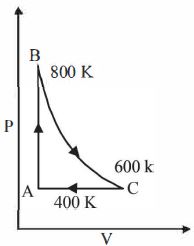
One mole of a diatomic ideal gas undergoes a cyclic process $ABC$ as shown in figure. The process $BC$ is adiabatic. The temperatures at $A, B$ and $C$ are $400\ K, 800\ K $ and $600\ K$ respectively. Choose the correct statement
When a spring is stretched by $2\,\, cm$ , it stores $100\,\, J$ of energy. If it is stretched further by $2\,\, cm$ , the stored energy will be increased by ............. $\mathrm{J}$
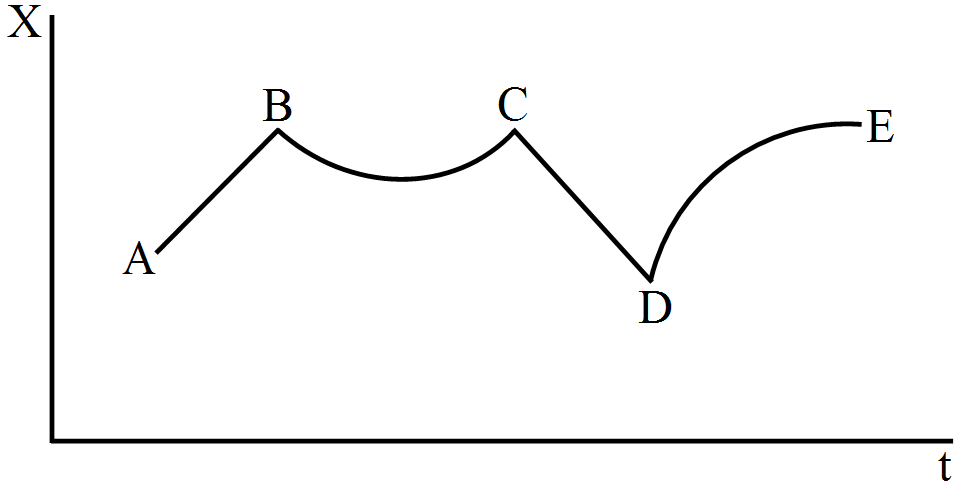
Figure shows the displacement of a particle going along the $X-$axis as a function of time. The force acting on the particle is zero in the region:
  1. $AB$
  2. $BC$
  3. $CD$
  4. $DE$
An inflated rubber balloon contains one mole of an ideal gas, has a pressure $P.$ volume $V$ and temperature $T.$ If the temperature rises to $1.1 T,$ and the volume is increased to $1.05V,$ the final pressure will be: