MCQ
A particle moves along the $X-$axis as $x = u(t - 2s) + a(t - 2s)^2.$
  • A
    The initial velocity of the particle is $u.$
  • B
    The accelerati? $n $ of the particle is $a.$
  • The acceleration of the particle is $2a.$
  • D
    At $t = 2s$ particle is at the origin.
Answer

Correct option: C.
The acceleration of the particle is $2a.$
Initial velocity $=\Big|\frac{\text{dx}}{\text{dt}}\Big|_{\text{t} = 0}$
$\frac{\text{dx}}{\text{dt}}=\text{u}+2\text{a}(\text{t}-2\text{s})$
$\Big|\frac{\text{dx}}{\text{dt}}\Big|_{\text{t}=0}=\text{u}-4\ \text{as}\neq\text{u}$
Acceleration $=\frac{\text{d}^2\text{x}}{\text{dt}^2}=2\text{a}$
At $t = 2s,$
$x = u(2s - 2s) + a(2s - 2s)^2 = 0 ($origin$)$

Need a full question paper?

Generate a complete, print-ready paper with questions like this in minutes — across 16+ boards, with answer keys.

Start Generating Free

Similar questions

A particle moving in a magnetic field increases its velocity, then its radius of the circle(a) Decreases(b) Increases(c) Remains the same(d) Becomes half
       
Six protons and six neutrons are brought together to form a carbon nucleus, but the mass of the carbon nucleus is less than the sum of the masses of the individual particles due to the mass defect, This deducted mass has been$:$
Let $F_{pp'} F_{pn}$ and $F_{nn}$ fill denote the magnitudes of the nuclear force by a proton on a proton, by a proton on a neutron and by a neutron on a neutron respectively. When the separation is $1$ fm:
The energy liberated on complete fission of $1 \ kg$ of $92^{\mathrm{U}^{285}}$ is (Assume 200 MeV energy is liberated on fission of $1$ nucleus$)$
$86^{\mathrm{A}^{222}} \rightarrow 84^{\mathrm{B}^{210}}$ In this reaction how many $\alpha$ and $\beta$  particles are emitted
The radius of a circle is stated as $2.12\ cm.$ Its area should be written as :
Assertion   :  The resistance of super-conductor is zero.
Reason      : The super-conductors are used for the transmission of electric power.(a) If both assertion and reason are true and the reason is the correct explanation of the assertion.(b) If both assertion and reason are true but reason is not the correct explanation of the assertion.(c) If assertion is true but reason is false.(d) If the assertion and reason both are false.


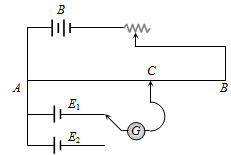
The circuit shown here is used to compare the $\text{e.m.f.}$ of two cells $E _1$ and $E _2\left( E _1> E _2\right)$. The null point is at $C$ when the galvanometer is connected to $E _1$. When the galvanometer is connected to $E _2$, the null point will be
A pure semiconductor at absolute zero has:
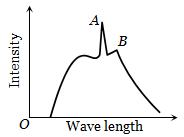
The figure represents the observed intensity of $X-$rays emitted by an $X-$ray tube as a function of wavelength. The sharp peaks $A$ and $B$ denote