MCQ
A particle moves in a circular path with a uniform speed. Its motion is:
  • Periodic.
  • B
    Oscillatory.
  • C
    Simple harmonic.
  • D
    Angular simple harmonic.

Answer

Correct option: A.
Periodic.
Because the particle covers one rotation after a fixed interval of time but does not oscillate around a mean position.

Need a full question paper?

Generate a complete, print-ready paper with questions like this in minutes — across 16+ boards, with answer keys.

Start Generating Free

Similar questions

Find the maximum tension in the spring if initially spring at its natural length when block is released from rest.
Albert Einstein introduced the concept of:
As compared to the person with white skin, the person with black skin will experience
Water rises in a vertical capillary tube upto a height of $2.0 \,cm $. If the tube is inclined at an angle of ${60^o}$ with the vertical, then upto what length the water will rise in the tube....... $cm$ 
Two simple pendulums whose lengths are $100 cm$ and $121 cm$ are suspended side by side. Their bobs are pulled together and then released. After how many minimum oscillations of the longer pendulum, will the two be in phase again
Two particles start simultaneously from the same point and move along two straight lines, one with uniform velocity $v$ and other with a uniform acceleration $a$. If $\alpha$ is the angle between the lines of motion of two particles, then the least value of relative velocity will be at time given by
A particle of mass $10\ kg$ is moving in a straight line. If its displacement, $x$ with time $t$ is given by $x = (t^3 - 2t - 10)m,$ then the force acting on it at the end of $4$ seconds is:
A rocket has a mass of $100 \,kg$. $90\%$ of this is fuel. It ejects fuel vapours at the rate of $1 \,kg/sec$ with a velocity of $500\, m/sec$ relative to the rocket. It is supposed that the rocket is outside the gravitational field. The initial upthrust on the rocket when it just starts moving upwards  is ......... $N$
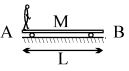
The figure shows a man of mass $m$ standing at the end $A$ of a trolley of mass $M$ placed at rest on a smooth horizontal surface. The man starts moving towards the end $B$ with a velocity $u_{rel}$ with respect to the trolley. The length of the trolley is $L$. The velocity of the man with respect to ground $v_1$ will be
Thermal expansion of a solid is due to the