Question
A particle moves in a circular path with a continuously increasing speed. Its motion is:
  1. Periodic.
  2. Oscillatory.
  3. Simple harmonic.
  4. None of them.

Answer

  1. None of them.
Explanation:
As the particle does not complete one rotation in a fixed interval of time, neither does it oscillate around a mean position.

Need a full question paper?

Generate a complete, print-ready paper with questions like this in minutes — across 16+ boards, with answer keys.
Start Generating Free

Similar questions

A heavy ring of mass m is clamped on the periphery of al light circular disc. A small particle having equal mass is clamped at the centre of the disc. The system is rotated in such a way that the centre moves in a circle of radius r with a uniform speed v. We conclude that an external force:
  1. $\frac{\text{mv}^2}{\text{r}}$ must be acting on the central particle.
  2. $\frac{2\text{mv}^2}{\text{r}}$ must be acting on the central particle.
  3. $\frac{2\text{mv}^2}{\text{r}}$ must be acting on the system.
  4. $\frac{2\text{mv}^2}{\text{r}}$ must be acting on the ring.
An isolated solid metallic sphere is given +Q charge. The charge will be distributed on the sphere(a) Uniformly but only on surface(b) Only on surface but non-uniformly(c) Uniformly inside the volume(d) Non-uniformly inside the volume


At the surface of a charged conductor electrostatic field must be _____ to the surface at every point.
Image formed in compound microscope is :
A photon of energy hv is absorbed by o free electron of a metal having work function $\varphi<\text{hv}.$
To convert mechanical energy into electrical energy, one can use:
  1. DC dynamo.
  2. AC dynamo.
  3. Motor.
  4. Transformer.
A sample contains $16\ gm$ of a radioactive material, the half life of which is two days. After $32$ days, the amount of radioactive material left in the sample is
The viscous force acting between two layers of a liquid is given by $\frac{\text{F}}{\text{A}}=-\eta\frac{\text{dv}}{\text{dz}}$ This $\frac{\text{F}}{\text{A}}$ may be called:
  1. Pressure.
  2. Longitudinal stress.
  3. Tangential stress.
  4. Volume stress.
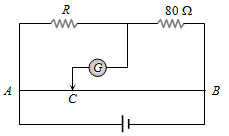
$AB$ is a wire of uniform resistance. The galvanometer $G$ shows no current when the length $AC = 20\ cm$ and $CB = 80 \ cm$. The resistance $R$ is equal to
There are 8 equal resistances R. Two are connected in parallel, such four groups are connected in series, the total resistance of the system will be(a) R / 2(b) 2 R(c) 4 R(d) 8 R