MCQ
A particle moves in a plane with constant acceleration in a direction different from the initial velocity. The path of the particle will be
  • A
    A straight line
  • B
    An arc of a circle
  • A parabola
  • D
    An ellipse

Answer

Correct option: C.
A parabola
c
(c) A particle moves with constant acceleration in a direction different from initial

velocity. Let the velocity be $v,$ acceleration be $a,$ angle between them is $\theta\left[\theta<90^{0}\right]$

Component of Velocity in the Direction of $a$ is $v \cos \theta$ and in a direction perpendicular to $a$ is vsin $\theta$

From equations of Kinematics, In the direction of acceleration, $y=v \cos \theta t+\frac{1}{2} a t^{2}-----(1)$

In the direction perpendicular to acceleration,

$x=v \sin \theta t$

$t=\frac{x}{v \sin \theta}--------(2)$

Substituting 2 in $1,$ we get:

$y=v \cos \theta\left(\frac{x}{v \sin \theta}\right)+\frac{1}{2} a\left(\frac{x^{2}}{\sin ^{2} \theta}\right)$

$y=\frac{x}{\tan \theta}+\frac{1}{2} a \frac{x^{2}}{\sin ^{2} \theta}$

This is in the form of a parabola: $y=A x^{2}+B x+C$

Need a full question paper?

Generate a complete, print-ready paper with questions like this in minutes — across 16+ boards, with answer keys.
Start Generating Free

Similar questions

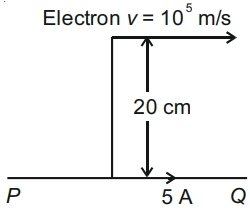
An infinitely long straight conductor carries a current of $5 \,\mathrm{~A}$ as shown. An electron is moving with a speed of $10^{5} \, \mathrm{~m} / \mathrm{s}$ parallel to the conductor. The perpendicular distance between the electron and the conductor is $20 \, \mathrm{~cm}$ at an instant. Calculate the magnitude of the force experienced by the electron at that instant in $\times 10^{-20} \,N$
Two particles $A$ and $B$ are projected simultaneously from a fixed point of the ground. Particle $A$ is projected on a smooth horizontal surface with speed $v$, while particle $B$ is projected in air with speed $\frac{2 v}{\sqrt{3}}$. If particle $B$ hits the particle $A$, the angle of projection of $B$ with the vertical is
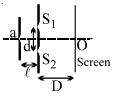
The figure shows a schematic diagram showing the arrangement of Young's Double Slit Experiment Identify the correct statement $(s)$ if the source slit $S$ moved closer to $S_1S_2$, i.e. the distance $\lambda$ decreases
A lift of mass $1000\,kg$ is moving with an acceleration of $1$ $m/{s^2}$ in upward direction. Tension developed in the string, which is connected to the lift, is  ........... $N$  $(g= 9.8\ m/{s^2})$
Four light waves are represented by

(i) $y = a_1\, sin\omega\, t$ 

(ii) $y = {a_2}\sin (\omega \,t + \phi )$

(iii) $y = {a_1}\sin 2\omega \,t$         

(iv) $y = {a_2}\sin 2(\,\omega \,t + \phi )$

Interference fringes may be observed due to superposition of

Two capillary tubes $  P$ and $Q$ are dipped in water. The height of water level in capillary $P$ is $2/3$ to the height in $Q$ capillary. The ratio of their diameters is
Three coherent waves of equal frequencies having amplitude $10 \,\, \mu m$, $4\,\,\mu m$ and $7 \,\,\mu m$ respectively, arrive at a given point with successive phase difference of $\pi /2$. The amplitude of the resulting wave in $mm$ is given by
A parallel plate capacitor of plate area $A$ and plate seperation $d$ is charged to potential difference $V$ and then the battery is disconnected. Aslab of dielectric constant $K$ is then inserted between the plates of the capacitor so as to fill the space between the plates. If $Q, E$ and $W$ denote respectively, the magnitude of charge on each plate, the electric field between the plates (after the slab is inserted) and the work done on the system, in question, in the process of inserting the slab, then 
A particle with restoring force proportional to displacement and resisting force proportional to velocity is subjected to a force $F\sin \omega t$. If the amplitude of the particle is maximum for $\omega = {\omega _1}$ and the energy of the particle is maximum for $\omega = {\omega _2}$, then (where ${\omega _0}$ natural frequency of oscillation of particle)
If the radius of earth is reduced to three-fourth of its present value without change in its mass then value of duration of the day of earth will be__________.hours $30$ minutes.