MCQ
A particle moves with constant angular velocity in a circle. During the motion its
  • Energy is conserved
  • B
    Momentum is conserved
  • C
    Energy and momentum both are conserved
  • D
    None of the above is conserved

Answer

Correct option: A.
Energy is conserved
a
(a)In uniform circular motion (constant angular velocity) kinetic energy remains constant but due to change in velocity of particle its momentum varies.

Need a full question paper?

Generate a complete, print-ready paper with questions like this in minutes — across 16+ boards, with answer keys.

Start Generating Free

Similar questions

Doppler shift in frequency does not depend upon

Match List-I with List-II.

List-IList-II
(A)Isothermal(I)$\Delta \mathrm{W}$ (work done) $=0$
(B)Adiabatic(II)$\Delta \mathrm{Q}$ (supplied heat) $=0$
(C)Isobaric(III)$\Delta \mathrm{U}$ (change in internal energy) $\neq 0$
(D)Isochoric(IV)$\Delta \mathrm{U}=0$
Choose the correct answer from the options given below :
When two sound waves with a phase difference of $\pi /2$, and each having amplitude $A$ and frequency $\omega $, are superimposed on each other, then the maximum amplitude and frequency of resultant wave is
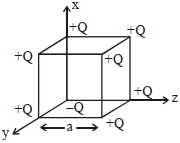
A cube of side $'a'$ has point charges $+Q$ located at each of its vertices except at the origin where the charge is $- Q$. The electric field at the centre of cube is
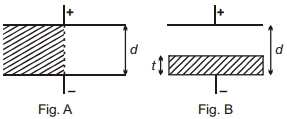
A capacitor is half filled with a dielectric $(K=2)$ as shown in figure A. If the same capacitor is to be filled with same dielectric as shown, what would be the thickness of dielectric so that capacitor still has same capacity?
A fraction $f_1$ of a radioactive sample decays in one mean life, and a fraction $f_2$ decays in one half-life.
If the refractive index of the material of a prism is $\cot \left(\frac{ A }{2}\right)$, where $A$ is the angle of prism then the angle of minimum deviation will be
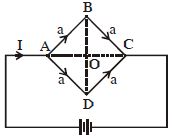
Magnetic field at the centre $O$ of a square loop of side $'a'$ carrying current $I$ as shown in the figure is
$5$ amperes of current is passed through a metallic conductor. The charge flowing in one minute in coulombs will be
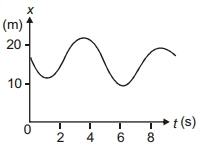
Figure shows the position of a particle moving on the $x$-axis as a function of time