Question
A particle moving with kinetic energy $E$ has de Broglie wavelength $\lambda$. If energy $\Delta \mathrm{E}$ is added to its energy, the wavelength become $\frac {\lambda}{2} .$ Value of $\Delta \mathrm{E},$ is 

Answer

de-Broglie wavelength $=\frac{\mathrm{h}}{\sqrt{2 \mathrm{mE}}}=\lambda$

Also, $\frac{\mathrm{h}}{\sqrt{2 \mathrm{m}(\mathrm{E}+\Delta \mathrm{E})}}=\frac{\lambda}{2}$

$\therefore \quad \frac{\mathrm{E}+\Delta \mathrm{E}}{\mathrm{E}}=4 \Rightarrow \Delta \mathrm{E}=3 \mathrm{E}$

Need a full question paper?

Generate a complete, print-ready paper with questions like this in minutes — across 16+ boards, with answer keys.
Start Generating Free

Similar questions

Two thin lenses are of same focal lengths $(f)$, but one is convex and the other one is concave. When they are placed in contact with each other, the equivalent focal length of the combination will be:
If $R$ and $H$ are the horizontal range and maximum height attained by a projectile, than its speed of projection is ..........
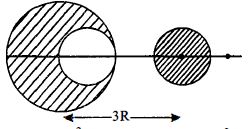
From a sphere of mass $M$ and radius $R$, a smaller sphere of radius $\frac{R}{2}$ is carved out such that the cavity made in the original sphere is between its centre and the periphery (See figure) . For the configuration in the figure where the distance between the centre of the original sphere and the removed sphere is $3R$, the gravitational force between the two sphere is
Two charged particles of mass $m$ and charge $q$ each are projected from origin simultaneously with same speed $V$ in transverse magnetic field. If ${\vec r_1}$ and ${\vec r_2}$ are the position vectors of particles (with respect to origin) at $t = \frac{{\pi m}}{{qB}}$ then the value of  ${\vec r_1}.{\vec r_2}$ at that time is
A particle executes SHM of amplitude A. The distance from the mean position when its's kinetic energy becomes equal to its potential energy is on
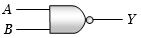
Which gates is represented by this figure
Which among the following, is a form of energy
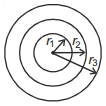
Figure shows three concentric metallic spherical shells. The outermost shell has charge $q_2$, the inner most shell has charge $q_1$, and the middle shell is uncharged. The charge appearing on the inner surface of outermost shell is
Steel wire of length ' $L$ ' at $40^{\circ} C$ is suspended from the ceiling and then a mass ' $m$ ' is hung from its free end. The wire is cooled down from $40^{\circ} C$ to $30^{\circ} C$ to regain its original length ' $L$ '. The coefficient of linear thermal expansion of the steel is $10^{-5} /{ }^{\circ} C$, Young's modulus of steel is $10^{11} N / m ^2$ and radius of the wire is $1 \ mm$. Assume that $L \gg$ diameter of the wire. Then the value of ' $m$ ' in $kg$ is nearly
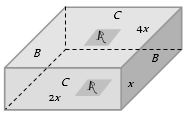
In figure shows a rectangular block with dimensions $x,\, 2x$ and $4x$. Electrical contacts can be made to the block between opposite pairs of faces (for example, between the faces labelled $A-A, B-B$ and $C-C$). Between which two faces would the maximum electrical resistance be obtained ($A-A$ : Top and bottom faces, $B-B$ : Left and right faces, $C-C$ : Front and rear faces)