A particle of mass $5 × 10^{-5}\ kg$ is placed at lowest point of smooth parabola $x^2$ = $40y$ ($x$ and $y$ in $m$) (in $rad/s$). If it is displaced slightly such that it is constrained to move along parabola, angular frequency of oscillation will be approximately
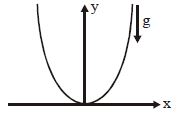
Diffcult
Download our app for free and get started
$\mathrm{F} =\mathrm{mg} \sin \theta $
$ \approx \mathrm{mg} \tan \theta $
$=\mathrm{mg} \frac{\mathrm{dy}}{\mathrm{dx}}=-\mathrm{mg} \times \frac{2 \mathrm{x}}{40} $
$\mathrm{a} =-\frac{\mathrm{x}}{2} \mathrm{m} $
$ \mathrm{a} =-\frac{-\mathrm{x}}{2} $
$ \omega =\frac{1}{\sqrt{2}} $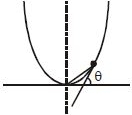

Download our appand get started for free
Experience the future of education. Simply download our apps or reach out to us for more information. Let's shape the future of learning together!No signup needed.*
Similar Questions
- 1Two similar sonometer wires given fundamental frequencies of $500Hz$. These have same tensions. By what amount the tension be increased in one wire so that the two wires produce $5$ beats/sec .... $\%$View Solution
- 2A transverse wave is represented by $y= Asin $ $\left( {\omega t - kx} \right)$. For what value of the wavelength is the wave velocity equal to the maximum particle velocity ?View Solution
- 3Two open organ pipes give $4$ beats/sec when sounded together in their fundamental nodes. If the length of the pipe are $100 cm$ and $102.5 cm$ respectively, then the velocity of sound is ..... $m/s$View Solution
- 4In a closed end pipe of length $105 \,\,cm,$ standing waves are set up corresponding to the third overtone. What distance from the closed end, amongst the following, is a pressure Node ..... $cm$ ?View Solution
- 5A string is stretched between fixed points separated by $75.0\ cm$. It is observed to have resonant frequencies of $420\ Hz$ and $315\ Hz.$ There are no other resonant frequencies between these two. Then, the lowest resonant frequency for this string is .... $Hz$View Solution
- 6View SolutionWhen sound waves travel from air to water, which of the following remains constant
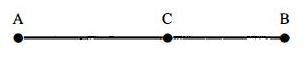
- 7$A$ and $B$ are two sources generating sound waves. A listener is situated at $C$ . The frequency of the source at $A$ is $500\,Hz$ . $A,$ now, moves towards $C$ with a speed $4\,m/s.$ The number of beats heard at $C$ is $6.$ When $A$ moves away from $C$ with speed $4\,m/s,$ the number of beats heard at $C$ is $18.$ The speed of sound is $340\,m/s.$ The frequency of the source at $B$ is ..... $Hz$View Solution
- 8The intensity of sound during the festival season increased by $100$ times. This could imply a decibel $(dB)$ level rise fromView Solution
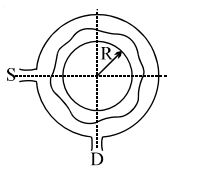
- 9A narrow tube is bent in the form of a circle of radius $R,$ as shown in the figure. Two small holes $S$ and $D$ are made in the tube at the positions right angle to each other. A source placed at $S$ generated a wave of intensity $I_0$ which is equally divided into two parts : One part travels along the longer path, while the other travels along the shorter path. Both the part waves meet at the point $D$ where a detector is placed If a maxima is formed at the detector then, the magnitude of wavelength $\lambda$ of the wave produced is given by $\pi R$View Solution
- 10Two sound sources when sounded simultaneously produce four beats in $0.25$ second. the difference in their frequencies must beView Solution