A particle of mass $m$ is moving along a trajectory given by
$x = x_0 + a\, cos\,\omega_1 t$
$y = y_0 + b\, sin\,\omega_2t$
The torque, acing on the particle about the origin, at $t = 0$ is
$x = x_0 + a\, cos\,\omega_1 t$
$y = y_0 + b\, sin\,\omega_2t$
The torque, acing on the particle about the origin, at $t = 0$ is
JEE MAIN 2019, Diffcult
Download our app for free and get started
$\overrightarrow{\mathrm{F}}=\mathrm{m} \overrightarrow{\mathrm{a}}=\mathrm{m}\left[-\mathrm{a} \omega_{1}^{2} \cos \omega, \mathrm{t} \hat{\mathrm{i}}-\mathrm{b} \omega_{2}^{2} \sin \omega_{2} \mathrm{t} \hat{\mathrm{j}}\right.$
$\overrightarrow{\mathrm{f}}_{\mathrm{t}-0}=-\mathrm{ma} \omega_{1}^{2} \hat{\mathrm{i}}$
$\overrightarrow{\mathrm{r}}_{\mathrm{t}-0}=\left(\mathrm{x}_{0}+\mathrm{a}\right) \hat{\mathrm{i}}+\mathrm{y} \hat{\mathrm{j}}$
$\vec{\tau}=\overrightarrow{\mathrm{r}} \times \overrightarrow{\mathrm{F}}=\mathrm{my}_{0} \mathrm{a} \omega_{1}^{2} \hat{\mathrm{k}}$

Download our appand get started for free
Experience the future of education. Simply download our apps or reach out to us for more information. Let's shape the future of learning together!No signup needed.*
Similar Questions
- 1Two simple harmonic motions are represented by the equations ${y_1} = 0.1\sin \left( {100\pi t + \frac{\pi }{3}} \right)$ and ${y_2} = 0.1\cos \pi t.$ The phase difference of the velocity of particle $1$ with respect to the velocity of particle $2$ isView Solution
- 2View SolutionIf a particle is executing simple harmonic motion, then acceleration of particle
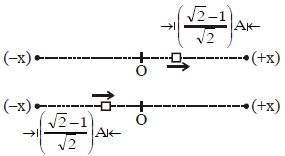
- 3Two bodies performing $SHM$ have same amplitude and frequency. Their phases at a certain instant are as shown in the figure. The phase difference between them isView Solution
- 4A ring of diameter $2m$ oscillates as a compound pendulum about a horizontal axis passing through a point at its rim. It oscillates such that its centre move in a plane which is perpendicular to the plane of the ring. The equivalent length of the simple pendulum is .... $m$View Solution
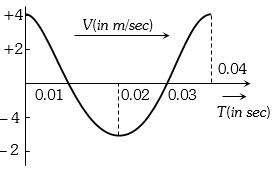
- 5The velocity-time diagram of a harmonic oscillator is shown in the adjoining figure. The frequency of oscillation is ..... $Hz$View Solution
- 6A mass $M$ is suspended from a spring of negligible mass. The spring is pulled a little and then released so that the mass executes $S.H.M.$ of time period $T$. If the mass is increased by m, the time period becomes $5T/3$. Then the ratio of $m/M$ isView Solution
- 7A simple pendulum, suspended from the ceiling of a stationary van, has time period $T$. If the van starts moving with a uniform velocity the period of the pendulum will beView Solution
- 8The displacements of two particles executing $S.H.M.$ on the same line are given. as $y_1=a \sin \left(\frac{\pi}{2} t+\phi\right)$ and $y_2=b \sin \left(\frac{2 \pi}{3} t+\phi\right)$. The phase difference between them at $t=1 \,s$ is .........View Solution
- 9The period of oscillation of a mass $M$ suspended from a spring of negligible mass is $T$. If along with it another mass $M$ is also suspended , the period of oscillation will now beView Solution
- 10The equation of motion of a particle is $\frac{{{d^2}y}}{{d{t^2}}} + Ky = 0$, where $K$ is positive constant. The time period of the motion is given byView Solution