A particle on the trough of a wave at any instant will come to the mean position after a time ($T =$ time period)
Easy
Download our app for free and get started
(b) The particle will come after a time $\frac{T}{4}$ to its mean position.

Download our appand get started for free
Experience the future of education. Simply download our apps or reach out to us for more information. Let's shape the future of learning together!No signup needed.*
Similar Questions
- 1The frequency of the first harmonic of a string stretched between two points is $100 Hz$. The frequency of the third overtone is ... $Hz$View Solution
- 2The velocity of sound in a gas at pressure $P$ and density $d$ isView Solution
- 3View SolutionThe intensity of sound increases at night due to
- 4View SolutionThe type of waves that can be propagated through solid is
- 5A plane wave is described by the equation $y = 3\cos \left( {\frac{x}{4} - 10t - \frac{\pi }{2}} \right)$. The maximum velocity of the particles of the medium due to this wave isView Solution
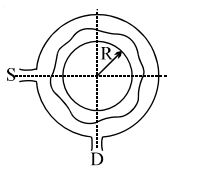
- 6A narrow tube is bent in the form of a circle of radius $R,$ as shown in the figure. Two small holes $S$ and $D$ are made in the tube at the positions right angle to each other. A source placed at $S$ generated a wave of intensity $I_0$ which is equally divided into two parts : One part travels along the longer path, while the other travels along the shorter path. Both the part waves meet at the point $D$ where a detector is placed If the minima is formed at the detector then, the magnitude of wavelength $\lambda$ of the wave produced is given byView Solution
- 7A tuning fork sounded together with a tuning fork of frequency $256$ emits two beats. On loading the tuning fork of frequency $256,$ the number of beats heard are $1$ per second. The frequency of tuning fork isView Solution
- 8A uniform tube of length $60.5\,cm$ is held vertically with its lower end dipped in water. A sound source of frequency $500\,Hz$ sends sound waves into the tube. When the length of tube above water is $16\,cm$ and again when it is $50\,cm,$ the tube resonates with the source of sound. Two lowest frequencies (in $Hz$), to which tube will resonate when it is taken out of water, are (approximately).View Solution
- 9Equation of motion in the same direction are given byView Solution
${y_1} = 2a\sin (\omega t - kx)$ and ${y_2} = 2a\sin (\omega t - kx - \theta )$
The amplitude of the medium particle will be
- 10How many times more intense is $90\,\, dB$ sound than $40\,\, dB$ sound?View Solution