MCQ
A particle performing uniform circular motion has.
  • A
    radial velocity and radial acceleration.
  • B
    radial velocity and transverse acceleration
  • transverse velocity and radial acceleration
  • D
    transverse velocity and transver acceleration.

Answer

Correct option: C.
transverse velocity and radial acceleration
C

Need a full question paper?

Generate a complete, print-ready paper with questions like this in minutes — across 16+ boards, with answer keys.
Start Generating Free

Similar questions

The unit of moment of force is same as _______________ .
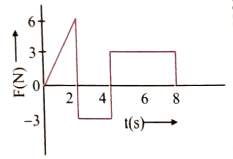
The force 'F' acting on a particle of mass 'm' is indicated by the force-time graph shown below. The change in momentum of the particle over the time interval from zero to 8 s is -
Image
An automobile travelling with a speed of 60 km $h^{-1}$ can apply brakes to stop after covering a distance of 20 m. If the car is going twice as fast i.e.. 120 km $h^{-1}$, the stopping distance will be
A uniform bar RS weighs 100 g and is 80 cm long. From the end R. two masses 50 g and 100 g are hung from the bar at a distance of 10 cm and 60 cm respectively. If the bar is to remain horizontal when balanced on a knife-edge, its position is
When a current I is set up in a wire of radius r, the drift speed is vd. If the same current is set up through a wire of radius 2r, then the drift speed will be
Let a steel bar of length $l$, breadth $b$ and depth $d$ be loaded at the centre by a load $W$. Then the sag or bending of beam is ( $Y=$ Young's modulus of material of steel)
For p-n junction in reverse bias, which of the following is true?
Calculate angular velocity of earth so that acceleration due to gravity at $60^{\circ}$ latitude becomes zero. (Radius of earth $=6400 km$, gravitational acceleration at poles $=10 m / s ^2, \cos 60^{\circ}=0.5$ )
A force $\overrightarrow{ F }=4 \hat{ i }-5 \hat{ j }+3 \hat{ k }$ is acting a point $\overrightarrow{r_1}=\hat{i}+2 \hat{j}+3 \hat{k}$. The torque acting about a point $\vec{r}_2=3 \hat{i}-2 \hat{j}-3 \hat{k}$ is
A cricket ball of mass 0.5 kg strikes a cricket bat normally with a velocity of 20 m $s ^{-1}$ and rebounds with a velocity of $10 m s ^{-1}$. The impulse of the force exerted by the ball on the bat is