MCQ
A particle projected from ground moves at angle $45^{\circ}$ with horizontal one second after projection and speed is minimum two seconds after the projection. The angle of projection of particle is [Neglect the effect of air resistance]
  • A
    $\tan ^{-1}(3)$
  • $\tan ^{-1}(2)$
  • C
    $\tan ^{-1}(\sqrt{2})$
  • D
    $\tan ^{-1}(4)$

Answer

Correct option: B.
$\tan ^{-1}(2)$
b
(b)

$\theta=45^{\circ}, t=1 \,s$

$\tan \phi=\frac{V_y}{U_y}=\frac{u \sin \theta-g t}{u \cos \theta}$

$\tan 45^{\circ}=\frac{u \sin \theta-g \times 1}{u \cos \theta} \Rightarrow u \cos \theta=u \sin \theta-g$

also, $V_y=0$, after $1^{\text {st }}$ (as speed is minimum)

$u \sin \theta-g \times 2=0$

$\Rightarrow u \sin \theta=2 g \ldots (i)$

so, $u \cos \theta=2 g-g$

$u \cos \theta=g \ldots (ii)$

so, $\frac{(i)}{(ii)}=\frac{u \sin \theta}{u \cos \theta}=\frac{2 g}{g}$

$\Rightarrow \tan \theta=2$

$\theta=\tan ^{-1}(2)$

Need a full question paper?

Generate a complete, print-ready paper with questions like this in minutes — across 16+ boards, with answer keys.

Start Generating Free

Similar questions

A ball of mass $0.5 \; kg$ is dropped from the height of $10 \; m$. The height, at which the magnitude of velocity becomes equal to the magnitude of acceleration due to gravity, is $\dots \; m$. (Use $g =10 \; m / s ^{2}$).
$A$ body $A$ is thrown vertically upwards with such a velocity that it reaches a maximum height of $h$. Simultaneously another body $B$ is dropped from height $h$. It strikes the ground and does not rebound. The velocity of $A$ relative to $B v/s$ time graph is best represented by : (upward direction is positive)
The kinematic equations of rectilinear motion for constant acceleration for a general situation, where the position coordinate at $t = 0$ is non$-$zero, say $x_0$ is:
A force of $2\hat i + 3\hat j + 4\hat k\;N$acts on a body for $4$ second, produces a displacement of $(3\hat i + 4\hat j + 5\hat k)m.$The power used is.......$W$
The approximate height from the surface of earth at which the weight of the body becomes $\frac{1}{3}$ of its weight on the surface of earth is $..........km$ : [Radius of earth $R =6400 \,km$ and $\sqrt{3}=1.732]$
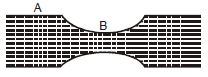
Water flows in a horizontal tube as shown in figure. The pressure of water changes by $600\, N/ m^2$ between $A$ and $B$ where the area of crosssection are $30\, cm^2$ and $15\, cm^2$ respectively. Find the rate of flow of water through the tube.
A lift is moving downwards with an acceleration equal to acceleration due to gravity. $A$ body of mass $M$ kept on the floor of the lift is pulled horizontally. If the coefficient of friction is $\mu $, then the frictional resistance offered by the body is
The pressure of a gas kept in an isothermal container is $200\ \text{kPa.}$ If half the gas is removed from it, the pressure will be:
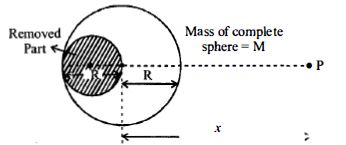
The gravitational field, due to the 'left over part' of a uniform sphere (from which a part as shown, has been 'removed out'), at a very far off point , $P$, located as shown, would be (nearly)
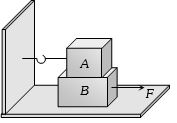
A block A with mass $100\, kg $ is resting on another block $B$ of mass $200\, kg$. As shown in figure a horizontal rope tied to a wall holds it. The coefficient of friction between $A$ and $B$ is $ 0.2 $ while coefficient of friction between $B$ and the ground is $0.3$. The minimum required force $F$ to start moving $B$ will be ........ $N$