MCQ
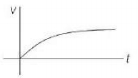
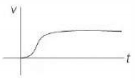
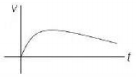
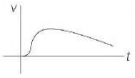
A particle released from rest is falling through a thick fluid under gravity. The fluid exerts a resistive force on the particle proportional to the square of its speed. Which one of the following graphs best depicts the variation of its speed $v$ with time $t$ ?

  • B

  • C

  • D

Answer

Correct option: A.

a
(a)

Velocity initially increases and this results in increase in resistive stokes force $(=6 \pi \eta r v)$.

After some time, resistive stokes force and force of buoyancy are equal to gravitational pull on the particle. After this instant velocity of particle becomes constant.

Hence, correct graph is $(a)$.

Need a full question paper?

Generate a complete, print-ready paper with questions like this in minutes — across 16+ boards, with answer keys.

Start Generating Free

Similar questions

$100 \,g$ of a iron ball having velocity $10 \,m/s$ collides with a wall at an angle ${30^o}$ and rebounds with the same angle. If the period of contact between the ball and wall is $0.1 \,second$, then the force experienced by the ball is ............. $\mathrm{N}$
A copper and a steel wire of the same diameter are connected end to end. A deforming force F is applied to this composite wire which causes a total elongation of 1cm. The two wires will have
The coordinates of a moving particle at any time $‘t’$ are given by $ x = \alpha t^3$ and $y = \beta t^3$. The speed of the particle at time $‘t’$ is given by
Two forces having magnitude $A$ and $\frac{ A }{2}$ are perpendicular to each other. The magnitude of their resultant is
In an experiment, the percentage of error occurred in the measurment of physical quantities $A, B, C$ and $D$ are $1 \%, 2 \%, 3 \%$ and $4 \%$ respectively. Then the maximum percentage of error in the measurement $X,$

where $X = \frac{{{A^2}{B^{\frac{1}{2}}}}}{{{C^{\frac{1}{3}}}{D^3}}}$, will be 

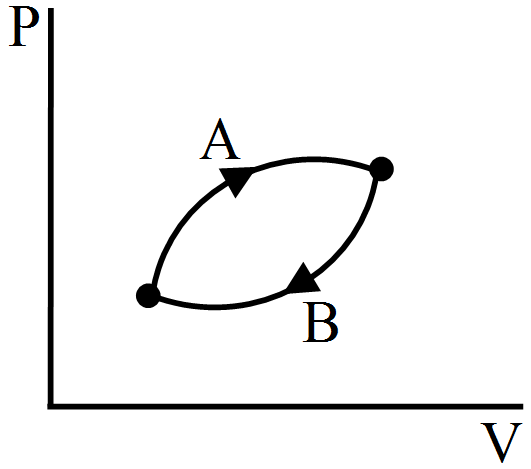
Refer to figure. Let $\Delta\text{U}_1$ and $\Delta\text{U}_2$ be the change in internal energy in processes A and B respectively, $\Delta\text{Q}$ be the net heat given to the system in process A + B and $\Delta \text{W}$ be the net work done by the system in the process A + B.

  1. $\Delta\text{U}_1+\Delta\text{U}_2=0$

  2. $\Delta\text{U}_1-\Delta\text{U}_2=0$

  3. $\Delta\text{Q}-\Delta\text{W}=0$

  4. $\Delta\text{Q}+\Delta\text{W}=0$

If $\gamma $ denotes the ratio of two specific heats of a gas, the ratio of slopes of adiabatic and isothermal $PV$ curves at their point of intersection is
A particle stays at rest as seen in a frame. We can conclude that:
  1. The frame is inertial.
  2. Resultant force on the particle is zero.
  3. The frame may be inertial but the resultant force on the particle is zero.
  4. The frame may be non-inertial but there is a non-zero resultant force.
A body has its centre of mass at the origin. the x-coordinates of the particles:
  1. May be all positive.
  2. May be all negative.
  3. May be all non-negative.
  4. May be positive for some cases and negative in other cases.
A body X is projected upwards with a velocity of 98ms−1, after 4s, a second body Y is also projected upwards with the same Y is also projected upwards with the same initial velocity. Two bodies will meet after: