MCQ
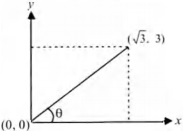
A particle starting from the origin $(0,0)$ moves in a straight line in the $(x, y)$ plane. Its coordinates at a later time are $(\sqrt 3,3)$ . The path of the particle makes with the $x -$ axis an angle of  ....... $^o$
  • A
    $0$
  • B
    $30$
  • C
    $45$
  • $60$

Answer

Correct option: D.
$60$
d
Let $\theta$ be the angle which the particle makes with an $x$ $-axis.$

From figure,

$\tan \theta=\frac{3}{\sqrt{3}}=\sqrt{3}$

or, $\theta=\tan ^{-1}(\sqrt{3})=60^{\circ}$

Need a full question paper?

Generate a complete, print-ready paper with questions like this in minutes — across 16+ boards, with answer keys.

Start Generating Free

Similar questions

What is the position vector of a point mass moving on a circular path of radius of $10m$ with angular frequency of $2 \text{rads}^{-1}$ after $\frac{\pi}{8}\text{s}?$ Initially the point was on $Y-$axis.
A block of mass $M$ is pulled along a horizontal frictionless surface by a rope of mass $M / 2$. If a force $2 Mg$ is applied at one end of the rope, the force which the rope exerts on the block is -
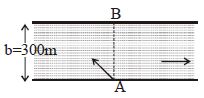
A river is flowing with velocity $5\ km/hr$ as shown in the figure. A boat starts from $A$ and reaches the other bank by covering shortest possible distance . Velocity of boat in still water is $3\ km/ hr$. The distance boat covers is    ......... $m$
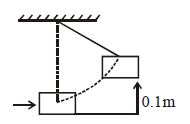
A bullet of mass $0.01\, kg$ and travelling at a speed of $500\, m/s$ strikes and passes horizontally through a block of mass $2\,kg$ which is suspended by string of string of length $5\,m$. The centre of gravity of the block is found to raise a vertical distance of $0.1\,m$. What is the speed of the bullet after it emerges from the block .......... $\mathrm{m}/ \mathrm{s}$ $[g = 9.8\,m/s^2]$ (time of passing of bullet is negligible)
If force $(\overrightarrow F ) = 4\hat i + 5\hat j$ and displacement $(\overrightarrow s ) = 3\hat i + 6\hat k$ then the work done is
An object may have:
$i.$ varying speed without having varying velocity.
$ii.$ varying velocity without having varying speed.
$iii.$ non-zero acceleration without having varying velocity.
$iv.$ non-zero acceleration without having varying speed.
A thin circular ring of mass $M$ and radius $R$ is rotating about its axis with a constant angular velocity $\omega$.  Four objects each of mass $m$, are kept gently to the opposite ends of two perpendicular diameters of the ring. The angular velocity of the ring will be 
The radius of gyration of a cylindrical rod about an axis of rotation perpendicular to its length and passing through the center will be $....m$ Given, the length of the rod is $10 \sqrt{3} m$.
$A$ block of mass $m$ moving with a velocity $v_0$ on a smooth horizontal surface strikes and compresses a spring of stiffness $k$ till mass comes to rest as shown in the figure. This phenomenon is observed by two observers:

$A$: standing on the horizontal surface

$B$: standing on the block 

To an observer $B$, when the block is compressing the spring

A long horizontal rod has a bead which can slide along its length, and initially placed at a distance $L$ from one end $A$ of the rod. The rod is set in angular motion about $A$ with constant angular acceleration $\alpha$. If the coefficient of friction between the rod and the bead is $\mu$, and gravity is neglected, then the time after which the bead starts slipping is