MCQ
A particle stays at rest as seen in a frame. We can conclude that:
  1. The frame is inertial.
  2. Resultant force on the particle is zero.
  3. The frame may be inertial but the resultant force on the particle is zero.
  4. The frame may be non$-$inertial but there is a non$-$zero resultant force.
  • A
    $A$ and $B$
  • B
    $B$ and $C$
  • C
    $A$ and $D$
  • $C$ and $D$

Answer

Correct option: D.
$C$ and $D$
According to Newton's second law which says that net force acting on the particle is equal to rate of change of momentum $($or mathematically $F = ma),$ so if a particle is at rest then $\text{F}_{\text{net}}=\text{ma = m}\frac{\text{dv}}{\text{dt}}=\text{m}\frac{\text{d}(0)}{\text{dt}}=\text{m}\times0=0.$
Now, if the frame is inertial, then the resultant force on the particle is zero.
If the frame is non$-$inertial, vector sum of all the forces plus a pseudo force is zero.
i.e $\text{F}_{\text{net}}\neq0.$

Need a full question paper?

Generate a complete, print-ready paper with questions like this in minutes — across 16+ boards, with answer keys.

Start Generating Free

Similar questions

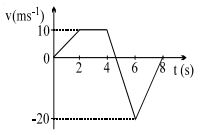
The figure shows a velocity-time graph of a particle moving along a straight line  The total distance travelled by the particle is  ........ $m$
$\frac{1}{2} $ mole of helium gas is contained in a container at $S.T.P.$ The heat energy needed to double the pressure of the gas, keeping the volume constant (specific heat of the gas $ = 3\,J\,g{m^{ - 1}}\,{K^{ - 1}})$ is ...... $J$
For a periodic motion represented by the equation $Y=\sin \omega t+\cos \omega t$ The amplitude of the motion is 
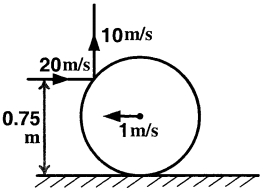
A thin ring of mass $2 \ kg$ and radius $0.5 \ m$ is rolling without slipping on a horizontal plane with velocity $1 \ m / s$. A small ball of mass $0.1 \ kg$, moving with velocity $20 \ m / s$ in the opposite direction, hits the ring at a height of $0.75 \ m$ and goes vertically up with velocity $10 \ m / s$. Immediately after the collision

$(A)$ the ring has pure rotation about its stationary $CM$.

$(B)$ the ring comes to a complete stop.

$(C)$ friction between the ring and the ground is to the left.

$(D)$ there is no friction between the ring and the ground.

The work done against gravity in taking $10 \,kg$ mass at $1\,m$ height in 1sec will be....$J$
On any planet, the presence of atmosphere implies (${C_{rms}}$= root mean square velocity of molecules and ${V_e}$= escape velocity)
The speeds of $5$ molecules of a gas (in arbitrary units) are as follows : $2, 3, 4, 5, 6.$ The root mean square speed for these molecules is
A body of mass $m$ is at rest. Another body of same mass moving with velocity $ V $ makes head on elastic collision with the first body. After collision the first body starts to move with velocity
The pitch of the screw gauge is $1\, mm$ and there are $100$ divisions on the circular scale. When nothing is put in between the jaws, the zero of the circular scale lies $8$ divisions below the reference line. When a wire is placed between the jaws, the first linear scale division is clearly visible while $72^{\text {nd }}$ division on circular scale coincides with the reference line. The radius of the wire is.........$mm$
A spring block system in horizontal oscillation has a time-period $T$. Now the spring is cut into four equal parts and the block is re-connected with one of the parts. The new time period of vertical oscillation will be