MCQ
A particle stays at rest as seen in a frame. We can conclude that,
  • A
    The frame is inertial.
  • B
    The frame may be non$-$inertial but there is a non zero resultant force.
  • C
    The frame may be inertial but resultant force on the particle is zero. 
  • $B$ and $C$

Answer

Correct option: D.
$B$ and $C$

Particle will be seen at rest only when frame is inertial and resultant force on particle is zero.
Also, if frame is non inertial $($i.e., accelerated$),$ the particle must also possess the same acceleration in magnitude and direction
i.e., resultant force on the particle must be non zero.

Need a full question paper?

Generate a complete, print-ready paper with questions like this in minutes — across 16+ boards, with answer keys.

Start Generating Free

Similar questions

Consider ten identical sources of sound all giving the same frequency but having phase angles which are random. If the average intensity of each source is ${I_0}$, the average of resultant intensity $I$ due to all these ten sources will be
A particle executes $S.H.M.,$ the graph of velocity as a function of displacement is :-
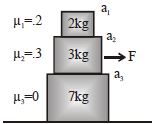
Find the acceleration of $a_1, a_2$ and $a_3$. If $10\,N$ force $F$ is applied on $3\,kg$ block :-
A particle moves along a straight line $OX$ . At a time $t$ (in seconds) the distance $x$ (in metres ) of the particle from $O$ is given by $x = 40 + 12t - {t^3}$.How long would the particle travel before coming to rest ?..........$m$
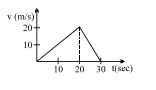
$v-t$ graph of an object of mass $1\,\, kg$ is shown
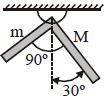
Two uniform rods of equal length but different masses are rigidly joined to form an $L-$ shaped body, which is then pivoted as shown in figure. If in equilibrium the body is in the shown configuration, ratio $M/m$ will be
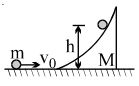
A particle of mass $m$ moving horizontally with $v_0$ strikes $a$ smooth wedge of mass $M$, as shown in figure. After collision, the ball starts moving up the inclined face of the wedge and rises to $a$ height $h$. Choose the correct statement related to the wedge $M$
Two bodies are thrown up at angles of $45^o $ and $60^o $, respectively, with the horizontal. If both bodies attain same vertical height, then the ratio of velocities with which these are thrown is
The three water filled tanks shown have the same volume and height. If small identical holes are punched near this bottom, which one will be the first to get empty.
Energy equals of a mass of one microgram in kilo joules is: