MCQ
A particle undergoes uniform circular motion.  About which point on the plane of the circle, will the angular momentum of the particle remain conserved
  • Centre of the circle
  • B
     On the circumference of the circle
  • C
    Inside the circle
  • D
    Outside the circle

Answer

Correct option: A.
Centre of the circle
a
The net force acting on a particle undergoing uniform circular motion is centripetal force which always passes through the centre of the circle. The torque due to this

force about the centre si zero, therfore, $L$ is conserved about $O.$

Need a full question paper?

Generate a complete, print-ready paper with questions like this in minutes — across 16+ boards, with answer keys.

Start Generating Free

Similar questions

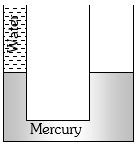
A $U-$ tube in which the cross-sectional area of the limb on the left is one quarter, the limb on the right contains mercury (density $13.6 g/cm^3$). The level of mercury in the narrow limb is at a distance of $36 cm$  from the upper end of the tube. What will be the rise in the level of mercury in the right limb if the left limb is filled to the top with water ........ $cm$
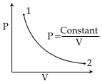
For the $P-V$ diagram given for an ideal gas, out of the following which one correctly represents the $T-P$ diagram ?
A physical quantity $A$ is dependent on other four physical quantities $p, q, r$ and $s$ as given below $A=\frac{\sqrt{pq}}{r^2s^3} .$ The percentage error of measurement in $p, q, r$ and $s$  $1\%,$ $3\%,\,\, 0.5\%$ and $0.33\%$ respectively, then the maximum percentage error in $A$ is .......... $\%$
Which of the following quantity is expressed as force per unit area
In a container having water filled upto a height $h,$ a hole is made in the bottom, the velocity of water following out of the hole is:
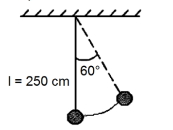
A pendulum is suspended by a string of length $250\,cm$. The mass of the bob of the pendulum is $200\,g$. The bob is pulled aside until the string is at $60^{\circ}$ with vertical as shown in the figure. After releasing the bob. the maximum velocity attained by the bob will be________ $ms ^{-1}$. (if $g=10\,m / s ^{2}$ )
If on heating liquid through $80°C$, the mass expelled is $(1/100)^{th}$ of mass still remaining, the coefficient of apparent expansion of liquid is
Two rods one made of copper and other made of steel of the same length and same cross sectional area are joined together. The thermal conductivity of copper and steel are $385\,J\,s ^{-1}\,K ^{-1}\,m ^{-1}$ and $50\,J\,s ^{-1}\,K ^{-1}\,m ^{-1}$ respectively. The free ends of copper and steel are held at $100^{\circ}\,C$ and $0^{\circ}\,C$ respectively. The temperature at the junction is, nearly $.......^{\circ}\,C$
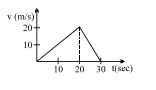
$v-t$ graph of an object of mass $1\,\, kg$ is shown
The first operation involved in a Carnot cycle is