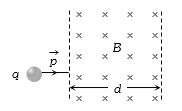
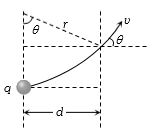
A particle with charge $q$, moving with a momentum $p$, enters a uniform magnetic field normally. The magnetic field has magnitude $B$ and is confined to a region of width $d$, where $d < \frac{p}{{Bq}}$, The particle is deflected by an angle $\theta $ in crossing the field
Diffcult


Download our appand get started for free
Experience the future of education. Simply download our apps or reach out to us for more information. Let's shape the future of learning together!No signup needed.*
Similar Questions
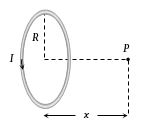
- 1A coil having $N$ $turns$ carry a current $I$ as shown in the figure. The magnetic field intensity at point $P$ isView Solution
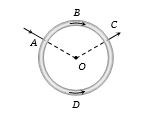
- 2A uniform wire is bent in the form of a circle of radius $R$. A current $I$ enters at $A$ and leaves at $C$ as shown in the figure :If the length $ABC$ is half of the length $ADC,$ the magnetic field at the centre $O$ will beView Solution
- 3View SolutionWhich of the following statement is true
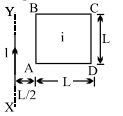
- 4A square loop $ABCD$, carrying a current $i,$ is placed near and coplanar with a long straight conductor $XY$ carrying a current $I,$ the net force on the loop will beView Solution
- 5An $\alpha $ particle and a proton travel with same velocity in a magnetic field perpendicular to the direction of their velocities, find the ratio of the radii of their circular pathView Solution
- 6View SolutionAn electron enters a magnetic field whose direction is perpendicular to the velocity of the electron. Then
- 7If induction of magnetic field at a point is $B$ and energy density is $U$ then which of the following graphs is correctView Solution
- 8$\alpha$ particle is revolving in radius $r$ with frequency $f$ then find value of magnetic dipole moment.View Solution
- 9Two infinitely long straight wires lie in the $\mathrm{xy}$-plane along the lines $\mathrm{x}=+R$. The wire located at $\mathrm{x}=+\mathrm{R}$ carries a constant current $\mathrm{I}_1$ and the wire located at $\mathrm{x}=-R$ carries a constant current $\mathrm{I}_2$. A circular loop of radius $R$ is suspended with its centre at $(0,0, \sqrt{3} R)$ and in a plane parallel to the xy-plane. This loop carries a constant current $/$ in the clockwise direction as seen from above the loop. The current in the wire is taken to be positive if it is in the $+\hat{\mathrm{j}}$ direction. Which of the following statements regarding the magnetic field $\dot{B}$ is (are) true?View Solution
$(A)$ If $I_1=I_2$, then B' cannot be equal to zero at the origin $(0,0,0)$
$(B)$ If $\mathrm{I}_1>0$ and $\mathrm{I}_2<0$, then $\mathrm{B}$ can be equal to zero at the origin $(0,0,0)$
$(C)$ If $\mathrm{I}_1<0$ and $\mathrm{I}_2>0$, then $\mathrm{B}$ can be equal to zero at the origin $(0,0,0)$
$(D)$ If $\mathrm{I}_1=\mathrm{I}_2$, then the $\mathrm{z}$-component of the magnetic field at the centre of the loop is $\left(-\frac{\mu_0 \mathrm{I}}{2 \mathrm{R}}\right)$
- 10View SolutionIf a current is passed through a spring then the spring will