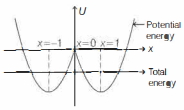
Correct option: C.between $x=-1.0 \,m$ to $x=0.0 \,m$
c
$(c)$ Given, potential energy of particle is
$U=\frac{x^{4}}{4}-\frac{x^{2}}{2}$
Differentiating with respect to $x$, we get
$\frac{d U}{d x}=\frac{4 x^{3}}{4}-\frac{2 x}{2}$
$=x^{3}-x$
$=x\left(x^{2}-1\right)$
For maxima or minima,
$\frac{d U}{d x} =0$
$\Rightarrow x\left(x^{2}-1\right) =0$
$\Rightarrow x=0 \text { or } x =\pm 1$
Differentiating again, we have
$\frac{d^{2} \tau}{d x^{2}}=3 x^{2}-1$
So, $\quad \frac{d^{2} U}{d x^{2}}=\left\{\begin{array}{c}-1 \text { at } x=0 \\ +2 \text { at } x=\pm 1\end{array}\right.$
So, by second derivative test, potential energy maxima occurs at $x=\pm 1$ and potential energy minima is at $x=0$.
Now, as at $t=0, x=-0.5 \,m$, so the particle is region $x=-1$ to $x=0$. As total encrgy of particle is negative, so particle cannot crosses $x=0$ mark