Question
A patient is suffering from ADA deficiency. Can he be cured? How?

Answer

A person suffering from ADA deficiency can be cured by various methods which are discusses below:
  • Bone Marrow Transplantation: This is a costly and risky surgical procedure. It requires a suitable donor which is difficult to find. An identical twin is supposed to be the best donor; because chances of tissue rejection are very high in bone marrow transplantation.
  • Enzyme Replacement Therapy: Enzyme replacement therapy is based on administering the missing enzyme to the patient by injection. This involves recurrent treatment that has escalated the cost this therapy.
  • Gene Therapy: Gene therapy involves taking out the lymphocytes from the patient’s blood. Then are lymphocytes are genetically engineered to add the missing gene. Recombinant lymphocytes are grown in suitable medium and then administered to the patient. This too is not a permanent cure because lymphocytes have a certain lifespan. The patient needs to be administered lymphocytes after frequent intervals. However, the gene isolated from marrow cells producing ADA is introduced into cells at early embryonic stage could be permanent cure for this disease.

Need a full question paper?

Generate a complete, print-ready paper with questions like this in minutes — across 16+ boards, with answer keys.

Start Generating Free

Similar questions

Read the following and answer any four questions from (i) to (v) given below:

Excessive exploitation of species, whether a plant or animal reduces the size of its population so it becomes vulnerable to extinction. Such as Dodo and passenger pigeon have become extinct due to over exploitation by humans. Thus the world is facing accelerated rates of species extinctions, largely due to human interference.

  1. Which of the following cause of biodiversity loss is not included in evil quartet?
  1. Coextinction.
  2. Pollution.
  3. Alien species invasion.
  4. Habitat loss and fragmentation.
  1. Identify the species that have become extinct due to over exploitation.
  1. Stellar sea cow.
  2. Yucca moth.
  3. Blatta orientalis.
  4. Nile Perch.
  1. Factors which make species susceptible to extinction are:
  1. Large population size.
  2. Lack of genetic variability.
  3. Ower status of trophic level.
  4. Ability to switch over to ahem ate foods.
  1. Assertion: Pollution reduces species biodiversity.

Reason: Spill over of oil in sea causes death of several marine animals.
  1. Both assertion and reason are true and reason is the correct explanation of assertion.
  2. Both assertion and reason are true but reason is not the correct explanation of assertion.
  3. Assertion is true but reason is false.
  4. Both assertion and reason are false.
  1. ________ is the first major cause of species extinction.
  1. Coextinction.
  2. Over exploitation.
  3. Habitat destruction.
  4. Alien species invasion.
Explain pBR322 with its cloning sites, enzymes with well labeled diagram.###Explain: cloning sites. (Diagram is not necessary)
Read the following and answer any four questions from (i) to (v) given below:
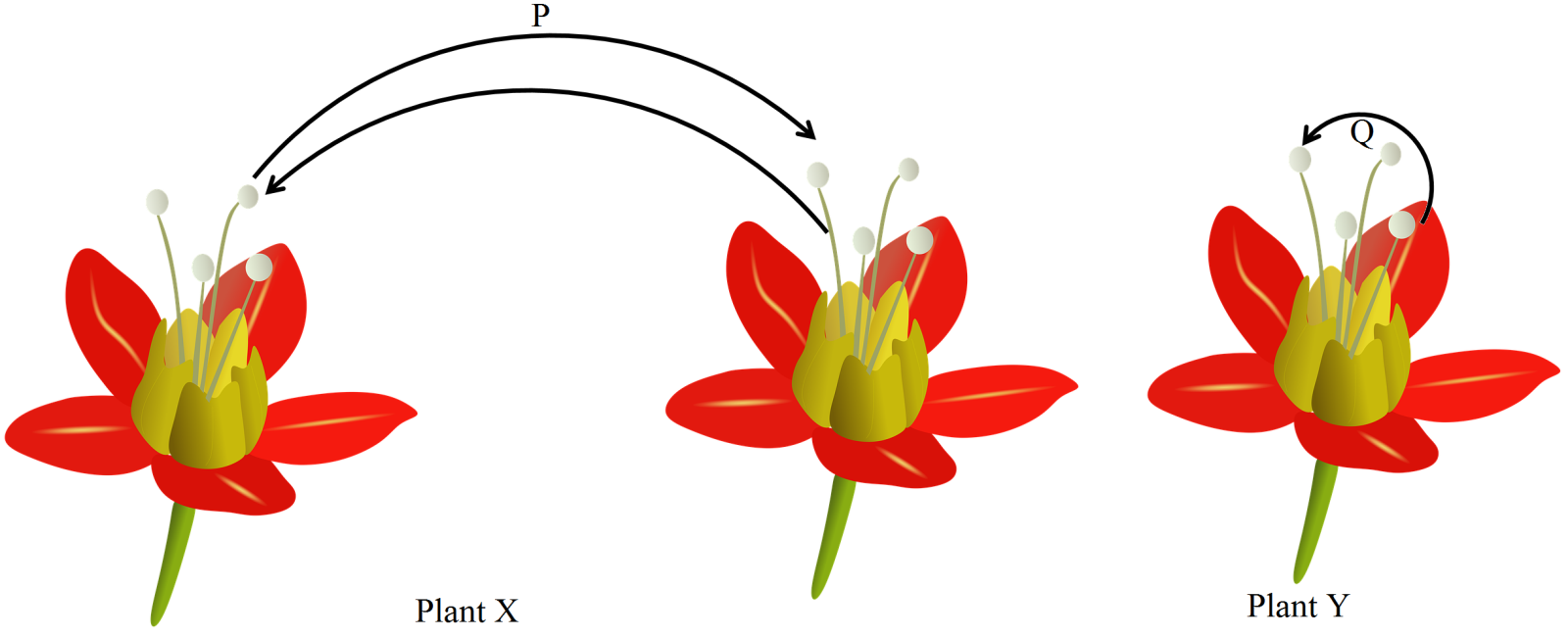
In angiosperms, the pollen grains are being transferred from the anther to the stigma and is termed pollination. This phenomenon was first discovered by Camerarius (1694) in the end of seventeenth century. Pollen grains are immobile. They cannot reach the stigma by themselves. An external agent is required for this. The pollination is mainly of two types-self pollination and cross pollination. The diagram given below shows two plants of the same species showing different types of pollination.

  1. What is transferred between the plants in the process indicated by arrow P?
  1. Ova.
  2. Pollen.
  3. Nutrients.
  4. Seeds.
  1. Which of the following statements is correct regarding processes P, Q and R?
  1. Processes P, Q and R introduce genetic variability in the offspring of sexually reproducing plants X and Y.
  2. Wind serves as agent for process Q if plants X and Y belong to Genus Salvia.
  3. Flowers of plants X and Y need to produce odour and nectar for completion of processes P and Q if they are entomophilous.
  4. If plants X and Y belong to Genus Cannabis, then their flowers need to produce sticky and heavy pollens in very small amount for accomplishment of process Q.
  1. Identify the processes P, Q and R.
S. No
P
Q
R
(a)
Geitonogamy
Xenogamy
Autogamy
(b)
Allogamy
Chasmogamy
Cleistogamy
(c)
Autogamy
Geitonogamy
Xenogamy
(d)
Geitonogamy
Allogamy
Autogamy
  1. In Catliarantl1us, the growth of style brings the stigma in contact of ripe anthers present on the mouth of corolla tube. This is an example of:
  1. Homogamy.
  2. Cleistogamy.
  3. Geitonogamy.
  4. Xenogamy.
  1. Which of the given processes represents a type of pollination that would result in greater adaptability of the particular species to potential environmental changes?
  1. P.
  2. Q.
  3. R.
  4. All of these.
Read the following and answer any four questions from (i) to (v) given below:

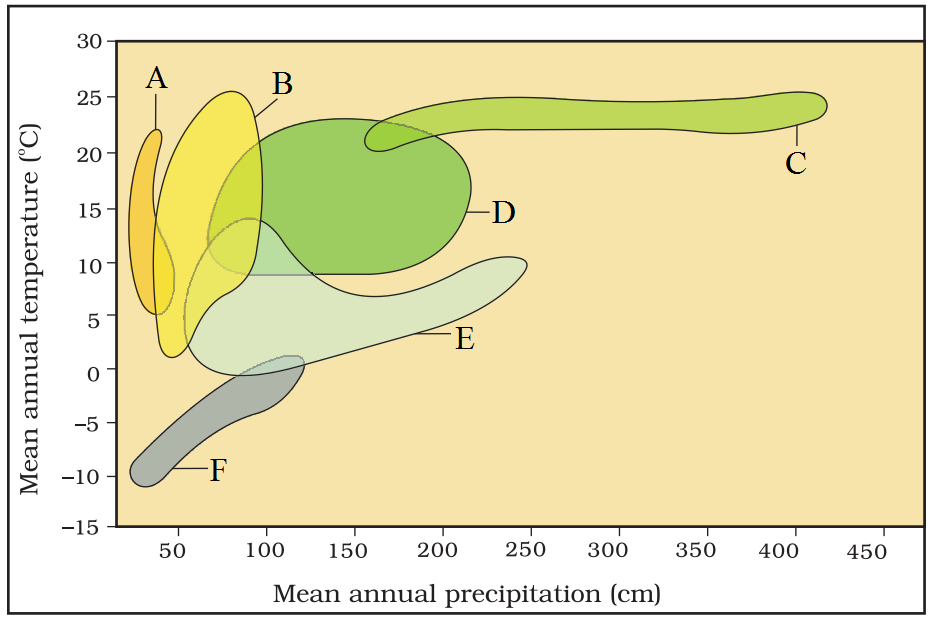
Organism P has thick lips and tongue so that it can easily feed on the commonly available spiny plants. Organism Q has thick layer of insulating fat under the skin. It was strong hooves to walk steadily on steep surfaces and lives in burrows during winters. Organism R has bright colours and sticky pads on its fingers and toes. It lives on trees.

  1. Which of the following is correct habitat for organisms P regarding its adaptation?
  1. Grassland biome.
  2. Desert biome.
  3. Tropical rainforest.
  4. Tropical deciduous forest.
  1. Which of the following is correct match regarding organism Q and its habitat?
  1. Tundra - Polar bear.
  2. Tropical rain forest - Deer.
  3. Grassland - Bighorn sheep.
  4. Desert - Camel.
  1. Which of the following is incorrect regarding organisms R's habitat?
  1. The vegetation shows stratification.
  2. Epiphytic growth is rich.
  3. Standing crop is highest.
  4. Deep rooted shrubs are common due to abundant sunlight.
  1. The dominant plants in habitat where P lives could be:
  1. Opuntia
  2. Nymphaea
  3. Deodar
  4. both (a) and (c).
  1. Organisms P, Q and R respectively most likely occur in:

  1. F, B and A.
  2. C, A, E.
  3. A, F and C.
  4. B, D and A.
Read the following and answer any four questions from (i) to (v) given below:

Regular change in temperature that occurs at specific intervals of time is called thennoperiodicity. It is of two types-diurnal and seasonal thermoperiodicity. Diumal periodicity refers to temperatures of day and night. It determines periods ofannual activity. In season periodicity different temperature prevails in different seasons of the year. 'Tiley favour different aspects of plant and animal life termed as phenology. For example in wheat, leaf growth requires a temperature of 10º-25ºC. Apple requires temperature below 7ºC for a period of 800 hrs before flowering and fruiting can occur. Low temperature is required for germination of some seeds as well as flowering in some plants. It also determines growth, reproduction, colour and morphology of animals. Both low and high temperature cause stress in organisms which is overcome by particular adaptations.

  1. Some plants require low temperature treatment for flowering. This phenomenon is known as:
  1. Photoperiodism.
  2. Vemalisation.
  3. Thermoperiodism.
  4. None of these.
  1. Animals found in arctic zones are called.
  1. microtherms
  2. Megatherms
  3. Mesotherms
  4. Hekistotherms
  1. Which of the following parts of wheat plant grows maximum in temperature around 10º-25ºC?
  1. Root
  2. Seeds
  3. Leaf
  4. Stem
  1. "Different temperatures prevail in different seasons of the year." It represents:
  1. Diurnal thermoperiodicity.
  2. Seasonal periodicity.
  3. Homeostasis.
  4. Thermoregulation.
  1. Assertion: Low and high temperature causes stress in organisms.

Reasons: Organisms show specific adaptations to overcome stressful condition.

  1. Both assertion and reason are true and reason is the correct explanation of assertion
  2. Both assertion and reason are true but reason is not the correct explanation of assertion.
  3. Assertion is true but reason is false.
  4. Both assertion and reason are false.
Read the following and answer any four questions from (i) to (v) given below:

ln many species of fig trees, there is a tight one-to-one relationship with the pollinator species of wasp. It means that a given fig species can be pollinated only by its 'partner' wasp species and no other species. The wasp pollinates the fig inflorescence while looking for suitable egg-laying sites. ln return for the favour of pollination, the fig offers the wasp some of its developing seeds as food for the developing wasp larvae.

  1. The interaction between fig trees and wasp is an example of:
  1. Mutualism
  2. Commensalism
  3. Amensalism
  4. Parasitism
  1. AD the given interactions are similar to interaction between fig trees and wasp, except.
  1. Plant and animal relation for pollination.
  2. Association of algae and fungi in lichens.
  3. Association of cattle egret and grazing cattle.
  4. Association of fungi and roots of higher plants in mycorrhiza.
  1. In which of the following interactions both partners are adversely affected?
  1. Parasitism
  2. Mutualism
  3. Competition
  4. Predation
  1. ln relationship between fig and wasp:
  1. One benefitted other harmed.
  2. Both are benefitted.
  3. One benefitted other unaffected.
  4. One inhibited, other unaffected.
  1. Assertion: Fig and wasp cannot complete their life cycle without each other.

Reason: They show mutualistic relationship.

  1. Both assertion and reason are true and reason is the correct explanation of assertion.
  2. Both assertion and reason are true but reason is not the correct explanation of assertion.
  3. Assertion is true but reason is false.
  4. Both assertion and reason are false.
Read the following and answer any four questions from (i) to (v) given below:

Study the given table and answer the questions based on it.

 
Hormone
Source
Function
(A)
Oxytocin
W
Ejection of milk
(B)
X
Anterior lobe of pituitary gland
Stimulates secretion of ABP from Sertoli cells
(C)
Y
Placenta
Maintains corpus luteum to secrete progesterone
(D)
Relaxin
Ovary
Z
  1. Identify the hormones X and Y, respectively.
  1. Testosterone, FSH.
  2. LH, hPL.
  3. FSH, hCG.
  4. ICSH, hCG.
  1. W in the given table is:
  1. Hypothalamus.
  2. Posterior lobe of pituitary.
  3. Placenta.
  4. Ovary.
  1. Which of the following is correct for Z?
  1. Dilation of uterine cervix during labour pains.
  2. Stimulates the growth of the mammary glands during pregnancy.
  3. Supports the fetal growth and prevents desiccation.
  4. Forms protective plug in cervix of uterus during pregnancy.
  1. Which set of hormones is secreted only during pregnancy?
  1. Human chorionic gonadotropin, relax in and human placental lactogen.
  2. Human placental lactogen, estrogen and chorionic thyrotropin.
  3. Human chorionic gonadotropin, human placental lactogen and progesterone.
  4. Chorionic thyrotropin, chorionic gonadotropin and estrogen.
  1. Assertion: Follicle stimulating hormone controls the maintenance and functions of male reproductive organs.

Reason: FSH acts directly on spermatogonia to stimulate sperm production.
  1. Both assertion and reason are true, and reason is the correct explanation of assertion.
  2. Both assertion and reason are true, but reason is not the correct explanation of assertion.
  3. Assertion is true, but reason is false.
  4. Both assertion and reason are false.
Assuming that within a population of beetles where Hardy Weinberg conditions are met, the colour black (B) is dominant over the colour red (b). 40% of all beetles are red (bb).
Given this information, answer the questions below:
A. What is the frequency of red beetles?
B. Calculate is the percentage of beetles in the population that are heterozygous.
C. What is the frequency of homozygous dominant individuals?
OR
D. Assuming that Hardy Wienberg conditions are met in the beetle population consisting of 1500 beetles. How many beetles would you expect to be black and red in colour respectively?
Describe: Genetic engineered insulin
Read the following text carefully and answer the questions that follow:
Cancer refers to any one of a large number of diseases characterized by the development of abnormal cells that divide uncontrollably and have the ability to infiltrate and destroy normal body tissue. Cancer often has the ability to spread throughout your body. Cancer is the second-leading cause of death in the world.
Image
i. How does a cancerous cell differ from a normal cell? (1)
ii. Benign tumor is less dangerous than malignant tumor. Why? (1)
iii. Describe causes of cancer. (2)
OR
Mention two methods of treatment of the disease. (2)