MCQ
A pendulum is swinging in an elevator. Its period will be greatest when the elevator is
  • A
    moving upwards at constant speed
  • B
    moving downwards
  • C
    moving downwards at constant speed
  • accelerating downwards

Answer

Correct option: D.
accelerating downwards
d
Time period of a simple pendulum is given by

$T=2 \pi \sqrt{\frac{l}{g}}$ or $T \propto \sqrt{\frac{l}{g}}$

when the elevator is accelerating downwards, the net gravitational acceleration is $(g-a),$ so, the time period when elevation is accelerating downwards, is greatest.

Need a full question paper?

Generate a complete, print-ready paper with questions like this in minutes — across 16+ boards, with answer keys.
Start Generating Free

Similar questions

The relation between time and distance is $t = \alpha {x^2} + \beta x$, where $\alpha $ and $\beta $ are constants. The retardation is
A projectile is fired with $KE$ of $1\,kJ$. If the range is maximum, .......... $J$ is its $KE$ at the highest point.
Three capacitors $2,\, 3$ and $6\  \mu F$ are joined in series with each other. What is the minimum effective capacitance......$\mu \,F$
Two magnets, each of magnetic moment $‘M’ $ are placed so as to form a cross at right angles to each other. The magnetic moment of the system will be
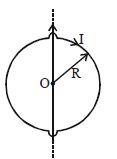
A circular conducting loop of radius $R$ carries a current $I.$ Another straight infinite conductor carrying current $I$ passes through the diameter of this loop as shown in the figure. The magnitude of force exerted by the straight conductor on the loop is
In the lowest energy level of hydrogen atom, the electron has the angular momentum
A circuit connected to an $ac$ source of $emf$ $e = e_0\, sin\, (1000t)$ with $t$ in seconds, gives a phase difference of $\frac{\pi }{4}$ between the $emf$ $e$ and current $i$. Which of the following circuits will exhibit this?
The mass and energy equivalent to $1\, a.m.u.$ respectively
A body of mass $m$ is accelerated uniformly from rest to a speed $v$ in a time $T$ . The instantaneous power delivered to the body as a function of time is given by
The earth revolves about the sun in an elliptical orbit with mean radius $9.3 \times {10^7}\,m$ in a period of $1$ year. Assuming that there are no outside influences