Question
A perfectly inelastic supply curve will be:
  1. Parallel to X-axis.
  2. Parallel to Y-axis.
  3. Downward sloping.
  4. None of these.

Answer

  1. Parallel to Y-axis.

Need a full question paper?

Generate a complete, print-ready paper with questions like this in minutes — across 16+ boards, with answer keys.
Start Generating Free

Similar questions

In which of the following market structure are entry barriers the highest?
  1. Perfect competition.
  2. Monopolistic competition.
  3. Oligopoly.
  4. Monopoly.
At the Break-Even point, Savings in the economy are:
  1. Positive.
  2. Zero.
  3. Negative.
  4. Maximum.
Stage II of Law of Variable Proportions is called:
  1. Diminishing returns.
  2. Decreasing returns.
  3. Falling returns.
  4. Negative returns.
National income differs from net national product at market price by the amount ________.
  1. current transfers from the rest of the world.
  2. net indirect taxes.
  3. national debt interest.
  4. it does not differ.
The process of adding to physical stock of capital is known as:
  1. Investment.
  2. Savings.
  3. Capital formation.
  4. Both (a) and (c).
Which of the following is not the feature of monopoly market?
  1. No close substitutes.
  2. Barriers to entry.
  3. Influence over price.
  4. Large number of buyers and sellers.
What can be the maximum value of Marginal Propensity to Save?
  1. 0
  2. 1
  3. 2
  4. 3
Due to change in price, if there is more than proportionate change in quantity supplied of a good, the supply is considered to be:
  1. Perfectly elastic.
  2. Relatively inelastic.
  3. Relatively elastic.
  4. Perfectly inelastic.
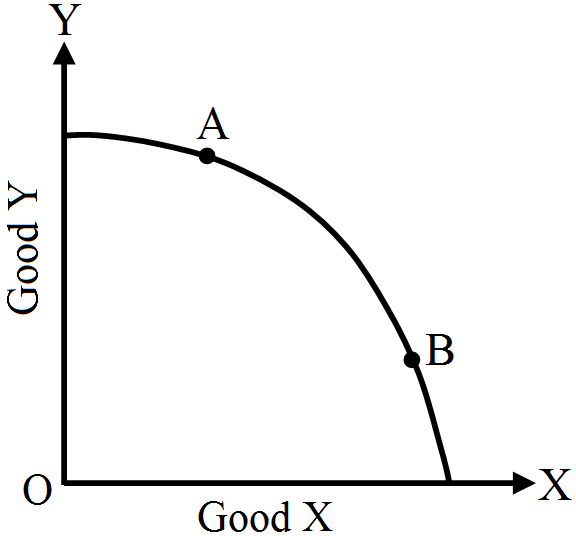
In the given figure, the movement on the production possibility curve from point A to point B shows _______. (Choose the correct alternative).
  1. Growth of all the resources in the economy.
  2. Underutilisation of resources.
  3. Production of more units of good X and less units of good Y.
  4. Production of more units of good Y and less units of good X.
As the consumer has more units of a commodity, his total utility from the commodity:
  1. Increases less than in proportion, reaches a maximum and then falls.
  2. Increases less than in proportion and then falls.
  3. Increases more than in proportion and then reaches a maximum.
  4. Falls, becomes zero and then negative.