MCQ
A permanent magnet has the capacity to attract:
  • A
    All substances.
  • B
    Some substances.
  • Only ferromagnetic substances.
  • D
    None of these options.

Answer

Correct option: C.
Only ferromagnetic substances.

A permanent magnet has the capacity to attract only ferromagnetic substances.

Need a full question paper?

Generate a complete, print-ready paper with questions like this in minutes — across 16+ boards, with answer keys.
Start Generating Free

Similar questions

The gravitational force between a $H-$atom and another particle of mass $m$ will be given by Newton’s law: $\text{F}=\text{G}\frac{\text{M.m}}{\text{r}^2}$, where $r$ is in $km$ and,
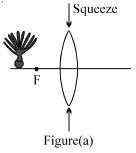
$A$ turnip sits before a thin converging lens, outside the focal point of the lens. The lens is filled with a transparent gel so that it is flexible; by squeezing its ends toward its center [as indicated in figure $(a)$], you can change the curvature of its front and rear sides. When you squeeze the lens, the image.
Beta rays emitted by a radioactive material are
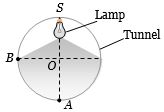
An electric lamp is fixed at the ceiling of a circular tunnel as shown is figure. What is the ratio the intensities of light at base A and a point B on the wall
In the grid circuit of a triode a signal $E=2 \sqrt{2} \cos \omega t$ is applied. If $m=14$ and $r_p=10 kW$ then root mean square current flowing through $R _{ L }=12 k \Omega$ will be
The momentum of a photon is $3.3 \times {10^{ - 29}}kg - m/sec$. Its frequency will be
Energy of an electron in an excited hydrogen atom is – 3.4 eV. Its angular momentum will be: $h=6.626 \times 10^{-34} \mathrm{~J}-\mathrm{s}$
A prism $(\mu = 1.5)$ has the refracting angle of $30^o $. The deviation of a monochromatic ray incident normally on its one surface will be ($sin 48^o  36’ = 0.75$)
An object is placed at $20cm$ from a convex mirror of focal length $10\,cm.$ The image formed by the mirror is
If an electron revolves in the path of a circle of radius of $0.5 × 10^{-10}\, m$ at frequency of $5 × 10^{15}$ $cycles/s$ the electric current in the circle is ..................$mA$ (Charge of an electron $=1.6 × 10^{-19}\, C$ )