A person blows into open-end of a long pipe. As a result, a high-pressure pulse of air travels down the pipe. When this pulse reaches the other end of the pipe then which of the following statements are true ?
$(I)$ a high-pressure pulse starts travelling up the pipe, if the other end of the pipe is open
$(II)$ a low -pressure pulse starts travelling up the pipe, if the other end of the pipe is open
$(III)$ a low pressure pulse starts travelling up the pipe, if the other end of the pipe is closed
$(IV)$ a high-pressure pulse starts travelling up the pipe, if the other end of the pipe is closed
Medium


Download our appand get started for free
Experience the future of education. Simply download our apps or reach out to us for more information. Let's shape the future of learning together!No signup needed.*
Similar Questions
- 1Two open organ pipes of length $25 cm$ and $25.5 cm$ produce $10$ beat/sec. The velocity of sound will be ..... $m/s$View Solution
- 2View SolutionSound waves in air are
- 3Beats are produced with the help of two sound waves of amplitudes $3$ and $5$ units. The ratio of maximum to minimum intensity in the beats isView Solution
- 4Two trains $A$ and $B$ are moving with speeds $20 \mathrm{~m} / \mathrm{s}$ and $30 \mathrm{~m} / \mathrm{s}$ respectively in the same direction on the same straight track, with $B$ ahead of $A$. The engines are at the front ends. The engine of train $A$ blows a long whistle.View Solution
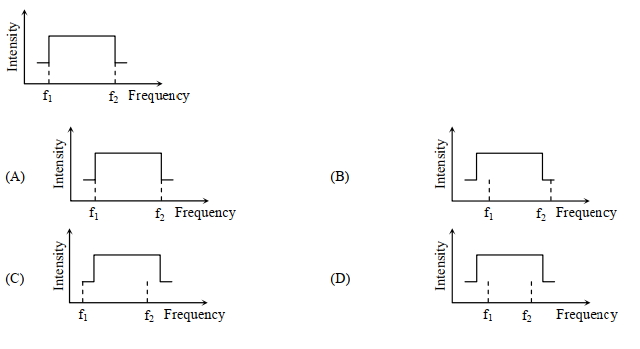
Assume that the sound of the whistle is composed of components varying in frequency from $f_1=800 \mathrm{~Hz}$ to $f_2=1120 \mathrm{~Hz}$, as shown in the figure. The spread in the frequency (highest frequency - lowest frequency) is thus $320 \mathrm{~Hz}$. The speed of sound in still air is $340 \mathrm{~m} / \mathrm{s}$.
$1.$ The speed of sound of the whistle is
$(A)$ $340 \mathrm{~m} / \mathrm{s}$ for passengers in $A$ and $310 \mathrm{~m} / \mathrm{s}$ for passengers in $B$
$(B)$ $360 \mathrm{~m} / \mathrm{s}$ for passengers in $A$ and $310 \mathrm{~m} / \mathrm{s}$ for passengers in $B$
$(C)$ $310 \mathrm{~m} / \mathrm{s}$ for passengers in $A$ and $360 \mathrm{~m} / \mathrm{s}$ for passengers in $B$
$(D)$ $340 \mathrm{~m} / \mathrm{s}$ for passengers in both the trains
$2.$ The distribution of the sound intensity of the whistle as observed by the passengers in train $\mathrm{A}$ is best represented by
$Image$
$3.$ The spread of frequency as observed by the passengers in train $B$ is
$(A)$ $310 \mathrm{~Hz}$ $(B)$ $330 \mathrm{~Hz}$ $(C)$ $350 \mathrm{~Hz}$ $(D)$ $290 \mathrm{~Hz}$
Give the answer question $1,2$ and $3.$
- 5Velocity of sound waves in air is $330\; m/sec$. For a particular sound in air, a path difference of $40 \;cm$ is equivalent to a phase difference of $1.6 \pi$. The frequency of this wave is... $Hz$View Solution
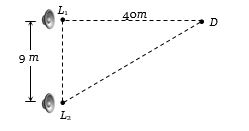
- 6Two loudspeakers $L_1$ and $L_2$ driven by a common oscillator and amplifier, are arranged as shown. The frequency of the oscillator is gradually increased from zero and the detector at $D$ records a series of maxima and minima. If the speed of sound is $330\,ms^{-1}$ then the frequency at which the first maximum is observed is .... $Hz$View Solution
- 7$Assertion :$ When a beetle moves along the sand within a few tens of centimeters of a sand scorpion, the scorpion immediately turns towards the beetle and dashes towards itView Solution
$Reason :$ When a beetle disturbs the sand, it sends pulses along the sand's surface. One set of pulses is longitudinal while the other set is transverse. - 8On a long horizontally moving belt, a child runs to and fro with a speed $9\, km\, h^{-1}$ (with respect to the belt) between his father and mother located $50\, m$ apart on the moving belt. The belt moves with a speed of $4\, km\, h^{-1}$. For an observer on a stationary platform, the speed of the child running in the direction of motion of the belt is ..... $km\,h^{-1}$View Solution
- 9The transverse displacement $y(x, t)$ of a wave on a string is given by $y(x, t)=e^{-\left(a x^2+b t^2+2 \sqrt{a b} x t\right)}$ This represents aView Solution
- 10Equation of the progressive wave is given by : $y = a\sin \pi (40t - x)$ where $a$ and $x$ are in metre and $t$ in second. The velocity of the wave is ..... $m/s$View Solution