MCQ
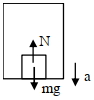
A person is standing in an elevator. In which situation, he experiences weight loss?
  • A
    When the elevator moves upward with constant acceleration
  • When the elevator moves downward with constant acceleration
  • C
    When the elevator moves upward with uniform velocity
  • D
    When the elevator moves downward with uniform velocity
Answer

Correct option: B.
When the elevator moves downward with constant acceleration
b
$mg - N = ma$

$\Rightarrow N = m ( g - a )$

$\therefore$ Person experiences weightloss, when acceleration of lift is downward.

Need a full question paper?

Generate a complete, print-ready paper with questions like this in minutes — across 16+ boards, with answer keys.

Start Generating Free

Similar questions

Starting from the rest, at the same time, a ring, a coin and a solid ball of same mass roll down an incline without slipping .The ratio of their translational kinetic energies at the bottom will be
A tuning fork of frequency 480Hz is used to vibrate a sonometer wire having natural frequency 410Hz. The wire will vibrate with a frequency.
$A$ rod is hinged at its centre and rotated by applying a constant torque starting from rest. The power developed by the external torque as a function of time is :
From the following displacement-time graph find out the velocity of a moving body
The process in which no heat enters or leaves the system is termed as
Two vectors $\dot{A}$ and $\dot{B}$ are defined as $\dot{A}=a \hat{i}$ and $\overrightarrow{\mathrm{B}}=\mathrm{a}(\cos \omega t \hat{\mathrm{i}}+\sin \omega t \hat{j}$ ), where a is a constant and $\omega=\pi / 6 \mathrm{rad} \mathrm{s}^{-1}$. If $|\overrightarrow{\mathrm{A}}+\overrightarrow{\mathrm{B}}|=\sqrt{3}|\overrightarrow{\mathrm{A}}-\overrightarrow{\mathrm{B}}|$ at time $t=\tau$ for the first time, the value of $\tau$, in, seconds, is. . . . . .
The velocity of projectile at the intial point $A$ is $\left( {2\hat i + 3\hat j} \right)$ $m/s $ . It's velocity (in $m/s$) at point $B$ is
A body $B$ lies on a smooth horizontal table and another body $A$ is placed on $B$. The coefficient of friction between $A$ and $B$ is $\mu $. What acceleration given to $B$ will cause slipping to occur between $A$ and $B$
The value of the sum of two vectors $\overrightarrow A $ and $\overrightarrow B $ with $\theta $ as the angle between them is
A mass $M$ is suspended from a spring of negligible mass. The spring is pulled a little and then released so that the mass executes $S.H.M.$ of time period $T$. If the mass is increased by m, the time period becomes $5T/3$. Then the ratio of $m/M$ is