MCQ
A person speaking normally produces a sound intensity of $40\,dB$ at a distance of $1\,m$. If the threshold intensity for reasonable audibility is $20\,dB,$ the maximum distance at which he can be heard clearly is ... $m$
  • A
    $4$
  • B
    $5$
  • $10 $
  • D
    $20$

Answer

Correct option: C.
$10 $
c
(c) $dB = 10{\log _{10}}\left( {\frac{I}{{{I_0}}}} \right)$; where ${I_0} = {10^{ - 12}}W{m^{ - 2}}$ 

Since $40 = 10{\log _{10}}\left( {\frac{{{I_1}}}{{{I_0}}}} \right)$==> $\frac{{{I_1}}}{{{I_0}}} = {10^4}$ ....$(i) $

Also $20 = 10{\log _{10}}\left( {\frac{{{I_2}}}{{{I_0}}}} \right)$ ==>$\frac{{{I_2}}}{{{I_0}}} = {10^2}$ ....$(ii) $

==> $\frac{{{I_2}}}{{{I_1}}} = {10^{ - 2}} = \frac{{r_1^2}}{{r_2^2}}$

==> $r_2^2 = 100r_1^2$==> ${r_2} = 10m$          $\{\because {r_1} = 1m\} $

Need a full question paper?

Generate a complete, print-ready paper with questions like this in minutes — across 16+ boards, with answer keys.

Start Generating Free

Similar questions

The kinetic energy of $SHM$ is $1/n$ time its potential energy. If the amplitude of the $SHM$ be $A$, then what is the displacement of the particle?
The absolute zero is that temperature at which:
On a particular day, the relative humidity is $100\%$ and the room temperature is $30^\circ C,$ then the dew point is:
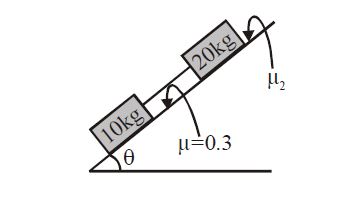
Value of $\theta$  is increased gradually from $\theta  = 0$ At $\theta=tan^{-1}(\frac{1}{2})$ both the block just start slipping. Then value of $\mu_2$ is : $(g = 10 m/s^2)$
A shell of mass $m$ is at rest initially. It explodes into three fragments having mass in the ratio $2: 2: 1$. If the fragments having equal mass fly off along mutually perpendicular directions with speed $v$, the speed of the third (lighter) fragment is :
Two forces having magnitude $A$ and $\frac{ A }{2}$ are perpendicular to each other. The magnitude of their resultant is
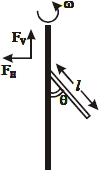
A uniform rod of length $'l'$ is pivoted at one of its ends on a vertical shaft of negligible radius When the shaft rotates at angular speed $\omega$ the rod makes an angle $\theta$ with it (see figure). To find $\theta$ equate the rate of change of angular momentum (direction going into the paper ) $\frac{ m \ell^{2}}{12} \omega^{2} \sin \theta \cos \theta$ about the centre of mass $(CM)$ to the torque provided by the horizontal and vertical forces $F_{H}$ and $F_{V}$ about the CM. The value of $\theta$ is then such that:
A given object takes $n$ times the time to slide down $45^{\circ}$ rough inclined plane as it takes the time to slide down an identical perfectly smooth $45^{\circ}$ inclined plane. The coefficient of kinetic friction between the object and the surface of inclined plane is :
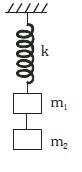
Two masses $m_1$ and $m_2$ are supended together by a massless spring of constant $k$. When the masses are in equilibrium, $m_1$ is removed without disturbing the system; the amplitude of vibration is
Newton's first law of motion describes the following