MCQ
A person suffering from myopia cannot see clearly :
- Anearby objects
- ✓distant objects
- Cneither near nor far objects
- Dhorizontal and vertical lines
Generate a complete, print-ready paper with questions like this in minutes — across 16+ boards, with answer keys.
The energy levels of the hydrogen spectrum is shown in figure. There are some transitions A, B, C, D and E. Transition A, B and C respectively represent
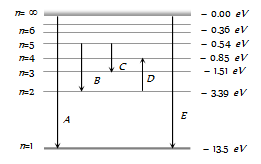
|
(a) First member of Lyman series, third spectral line of Balmer series and the second spectral line of Paschen series |
|
(b) Ionization potential of hydrogen, second spectral line of Balmer series and third spectral line of Paschen series |
|
(c) Series limit of Lyman series, third spectral line of Balmer series and second spectral line of Paschen series |
|
(d) Series limit of Lyman series, second spectral line of Balmer series and third spectral line of Paschen series |
If an electron jumps from 1st orbital to 3rd orbital, then it will
|
(a) Absorb energy |
(b) Release energy |
|
(c) No gain of energy |
(d) None of these |
An electron of mass m when accelerated through a potential difference V has de-Broglie wavelength λ. The de-Broglie wavelength associated with a proton of mass M accelerated through the same potential difference will be
|
(a) λ |
(b) λ |
(c) λ |
(d) λ |
A man is suffering from colour blindness for green colour. To remove this defect, he should use goggles of
|
(a) Green colour glasses |
(b) Red colour glasses |
|
(c) Smoky colour glasses |
(d) None of the above |
In Young’s double slit experiment, the intensity of light coming from the first slit is double the intensity from the second slit. The ratio of the maximum intensity to the minimum intensity on the interference fringe pattern observed is
|
(a) 34 |
(b) 40 |
(c) 25 |
(d) 38 |
A convex mirror has a focal length f. A real object is placed at a distance f in front of it from the pole produces an image at
|
(a) Infinity |
(b) f |
(c) f/2 |
(d) 2f |
$\text{v}=\frac{\text{v}_1+\text{v}_2}{2}$
$\text{v}=\sqrt{\text{v}_1\text{v}_2}$
$\frac{2}{\text{v}}=\frac{1}{\text{v}_1}+\frac{1}{\text{v}_2}$
$\frac{1}{\text{v}}=\frac{1}{\text{v}_1}+\frac{1}{\text{v}_2}$


