Question

✓
Answer
- (c) 4000Â.
Explanation:
$\lambda_\text{max}=\frac{\text{hc}}{\text{E}}=\frac{6.6\times10^{-34}\times3\times10^8}{2.5\times1.6\times10^{-19}}$
= 5000Â
$\therefore\lambda=4000\widehat{\text{A}}<\lambda_\text{max}$
- (b) D2
Explanation:
Energy of incident photon, $\text{E}=\frac{\text{hc}}{\lambda}$
$=\frac{6.6\times10^{-34}\times3\times10^8}{6\times10^{-7}\times1.6\times10^{-19}}=2.06\text{eV}$
The incident radiation can be detected by a photodiode if energy of incident photon is greater than the band gap.
As D2 = 2eV, therefore D2 will detect these radiations.
- (a) Which is always operated in reverse bias.
Explanation:
Photodiode is a device which is always operated in reverse bias.
- (c) 2.48eV
Explanation:
Let Eg be the required bandwidth. Then
$\text{E}_\text{g}=\frac{\text{hc}}{\lambda}$
Here, he = 1240eV nm,
$\lambda=500\text{nm}$
$\therefore\text{E}_\text{g}=\frac{1240\text{eVnm}}{500\text{nm}}=2.48\text{eV}.$
- (a) Optical signals.
Explanation:
A photodiode is a device which is used to detect optical signals.
Need a full question paper?
Generate a complete, print-ready paper with questions like this in minutes — across 16+ boards, with answer keys.
Explore more
Similar questions
In a TV picture tube electrons are ejected from the cathode with negligible speed and reach a velocity of 5 × 10⁶m/s in travelling one centimeter. Assuming straight line motion, find the constant force exerted on the electron. The mass of the electron is 9.1 × 10⁻³¹kg.
A container contains water upto a height of 20cm and there is a point source at the centre of the bottom of the container. A rubber ring of radius r floats centrally on the water. The ceiling of the room is 2.0m above the water surface.
→- Find the radius of the shadow of the ring formed on the ceiling if r = 15cm.
- Find the maximum value of r for which the shadow of the ring is formed on the ceiling. Refractive index of water $\frac{4}{3}.$
When some wax is rubbed on a cloth, it becomes waterproof. Explain.
A horizontal overhead power line carries a current of 90 A in east to west direction. What is the magnitude and direction of magnetic field due to the current 1.5 m in below the line?
- A small compass needle of magnetic moment ‘m’ is free to turn about an axis perpendicular to the direction of uniform magnetic field ‘B’. The moment of inertia of the needle about the axis is ‘I’. The needle is slightly disturbed from its stable position and then released. Prove that it executes simple harmonic motion. Hence deduce the expression for its time period.
- A compass needle, free to turn in a vertical plane orients itself with its axis vertical at a certain place on the earth. Find out the values of (i) horizontal component of earth’s magnetic field and (ii) angle of dip at the place.
Ampere's law gives a method to calculate the magnetic field due to given current distribution. According to it, the circulation $\oint\vec{\text{B}}.\text{d}\vec{\text{l}}$ di of the resultant magnetic field along a closed plane curve is equal to $\mu_0$ times the total current crossing the area bounded by the closed curve provided the electric field inside the loop remains constant. Ampere's law is more useful under certain synunetrical conditions. Consider one such case of a long Straight wire with circular cross-section (radius R) carrying current f uniformly distributed across this cross-section.
→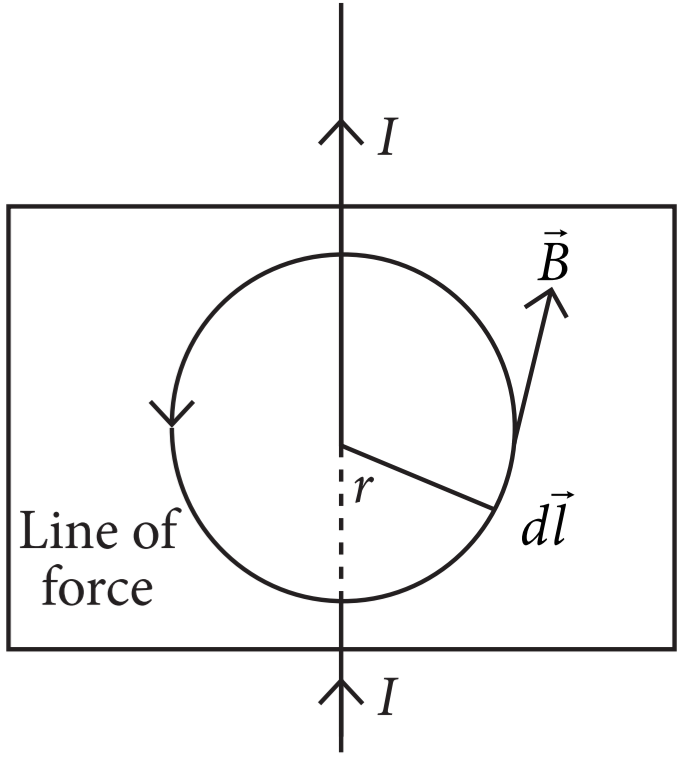
- The magnetic field at a radial distance r from the centre of the wire in the region r > R, is:
- $\frac{\mu_0\text{I}}{2\pi\text{r}}$
- $\frac{\mu_0\text{I}}{2\pi\text{R}}$
- $\frac{\mu_0\text{IR}^2}{2\pi\text{r}}$
- $\frac{\mu_0\text{Ir}^2}{2\pi\text{R}}$
- The magnetic field at a distance r in the region r < R is:
- $\frac{\mu_0\text{I}}{2\text{r}}$
- $\frac{\mu_0\text{Ir}^2}{2\pi\text{R}^2}$
- $\frac{\mu_0\text{I}}{2\pi\text{r}}$
- $\frac{\mu_0\text{Ir}}{2\pi\text{R}^2}$
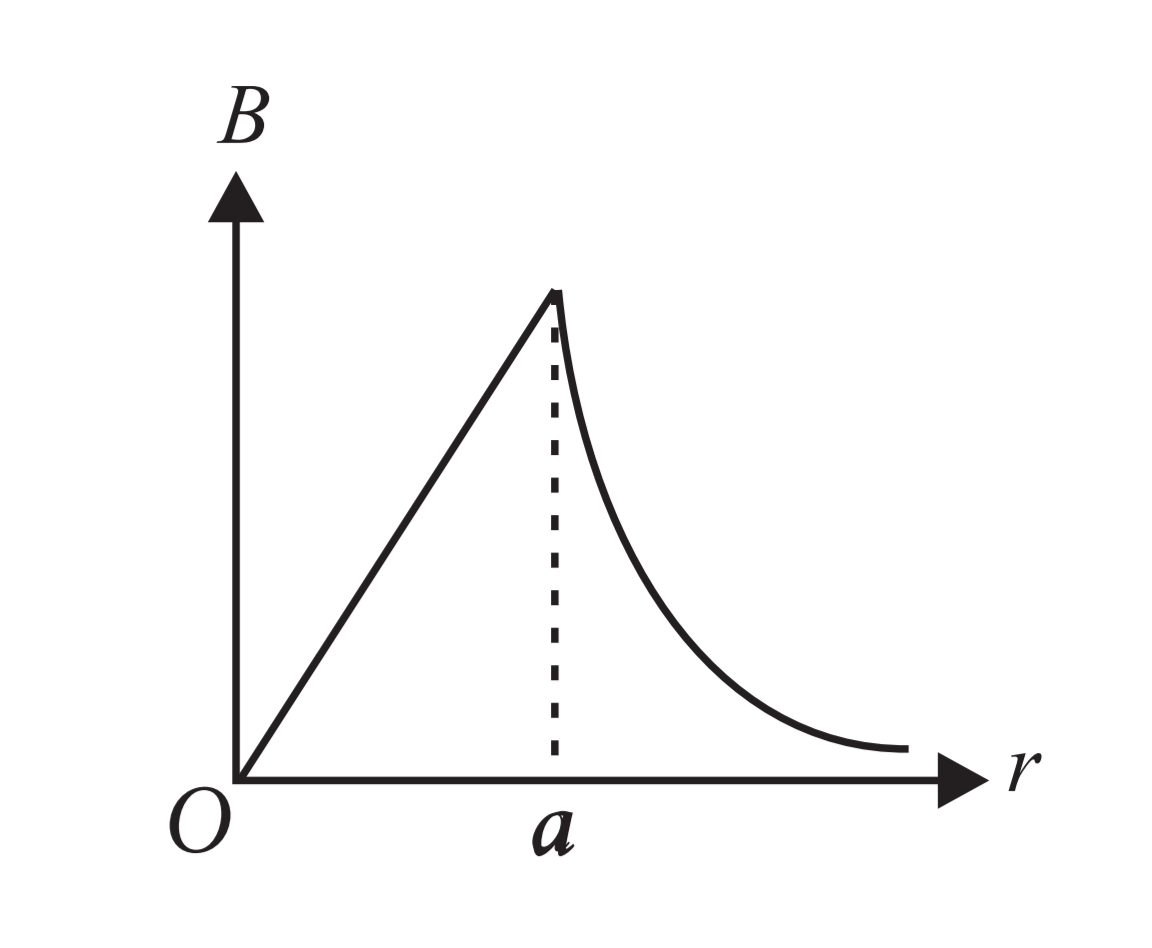
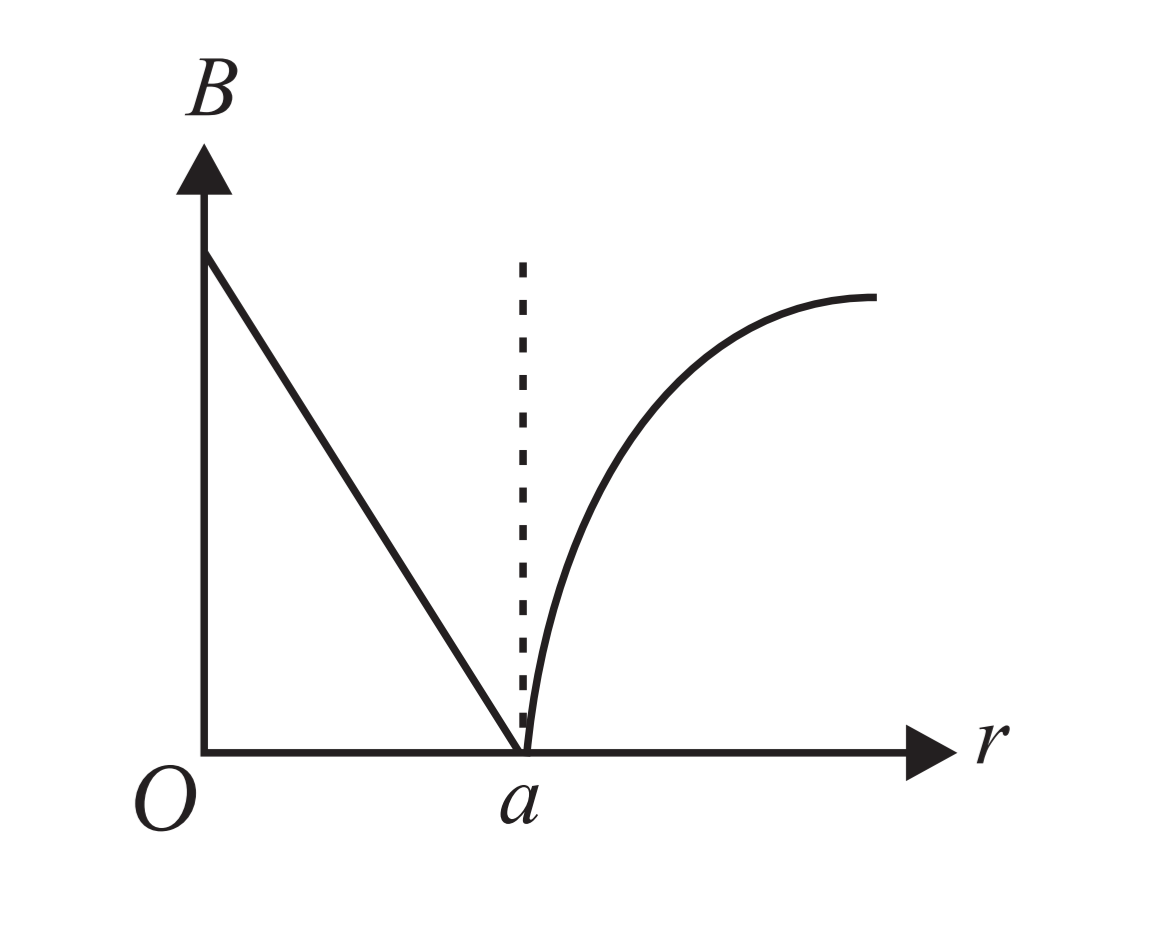
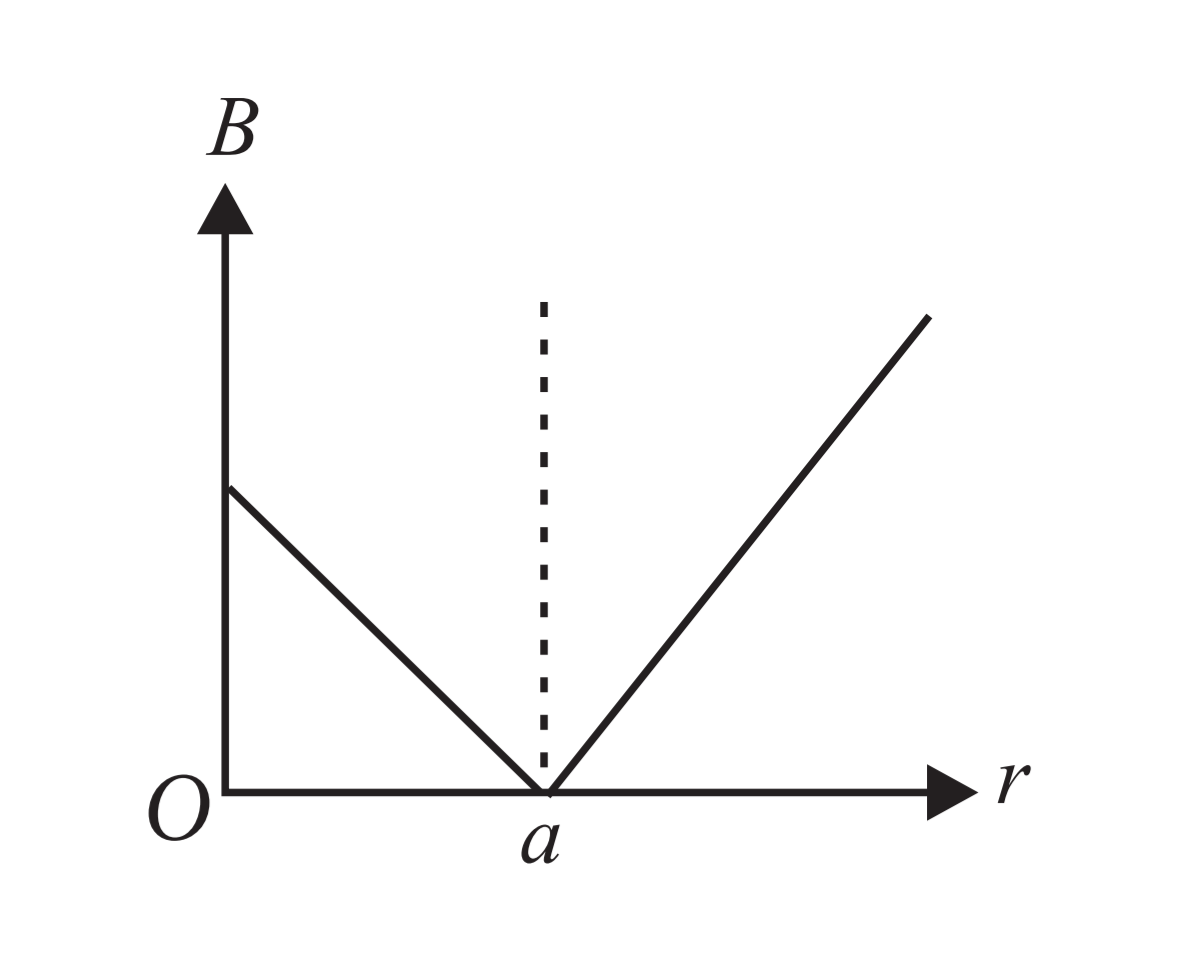
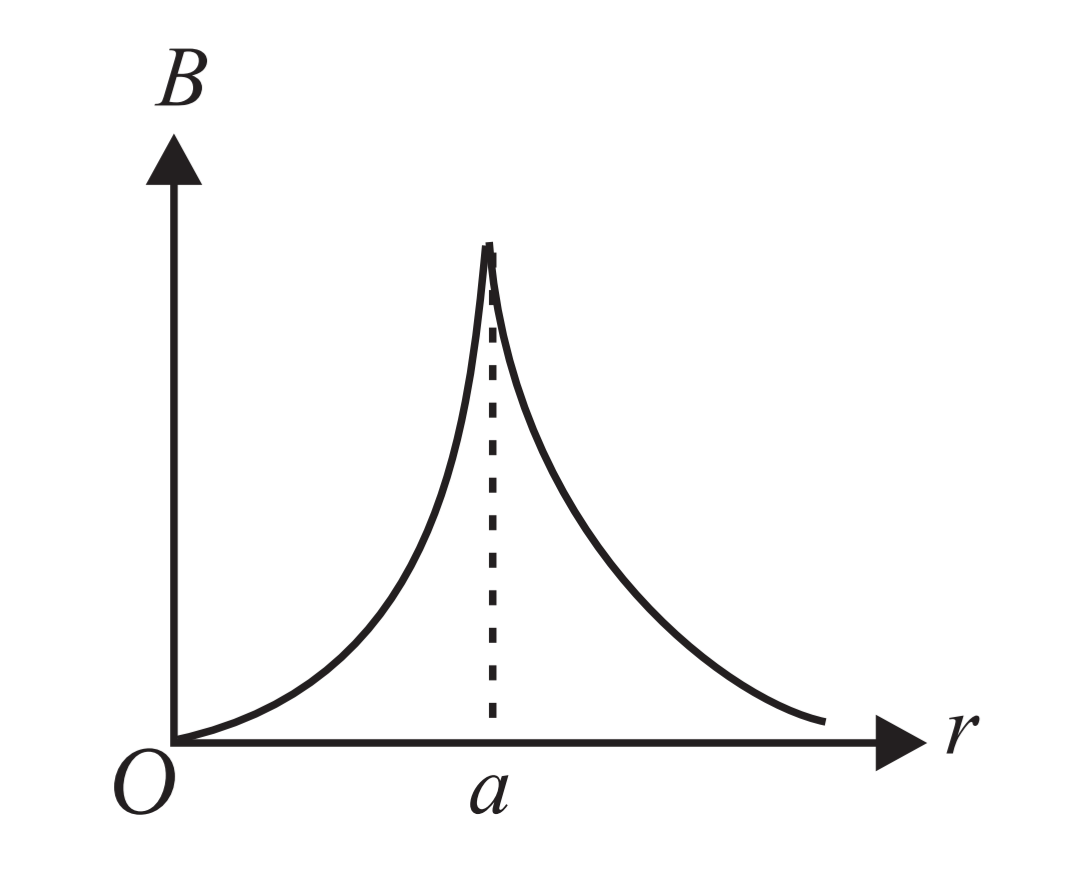
- A long straight wire of a circular cross section (radius a) carries a steady current I and the current I is uniformly distributed across this cross-section. Which of the following plots represents the variation of magnitude of magnetic field B with distance r from the centre of the wire?
- A long straight wire of radius R carries a steady current I. The current is uniformly distributed across its cross-section. The ratio of magnetic field at $\frac{\text{R}}{2}$ and 2R is:
- $\frac{\text{1}}{\text{2}}$
- $2$
- $\frac{\text{1}}{\text{4}}$
- $1$
- A direct current I flows along the length of an infinitely long straight thin walled pipe, then the magnetic field is:
- Uniform throughout the pipe but not zero.
- Zero only along the axis of the pipe.
- Zero at any point inside the pipe.
- Maximum at the centre and minimum at the edges.
A magnetic needle is free to rotate in a vertical plane which makes an angle of 60° with the magnetic meridian. If the needle stays in a direction making an angle of $\tan^{-1}\Big(\frac{2}{\sqrt{3}}\Big)$ with the horizontal, what would be the dip at that place?
→When the electron orbiting in hydrogen atom in its ground state moves to the third excited state, show how the de Broglie wavelength associated with it would be affected.

Why do marine animals live deep inside a lake when the surface of the lake freezes?