Question
A photoelectric material having work-function $\phi_0$ is illuminated with light of wavelength $\lambda\left(\lambda<\frac{\mathrm{hc}}{\phi_0}\right)$. The fastest photoelectron has a de Broglie wavelength $\lambda_d$. A change in wavelength of the incident light by $\Delta \lambda$ results in change $\Delta \lambda_{\mathrm{d}}$ in $\lambda_{\mathrm{d}}$. then the ratio $\Delta \lambda_{\mathrm{d}} / \Delta \lambda$ is proportional to
Answer

$\frac{\mathrm{P}^2}{2 \mathrm{~m}}=\frac{\mathrm{hc}}{\lambda}-\phi_0$

$\frac{\mathrm{h}^2}{2 \mathrm{~m} \cdot \lambda_{\mathrm{D}}^2}=\frac{\mathrm{hc}}{\lambda}-\phi_0$

$-\frac{\mathrm{h}^2}{\mathrm{~m}} \frac{1}{\lambda_{\mathrm{D}}^3} \mathrm{~d} \lambda_{\mathrm{D}}=\frac{\mathrm{hc}}{\lambda^2} \mathrm{~d} \lambda$

$\frac{\Delta \lambda_{\mathrm{D}}}{\Delta \lambda} \propto \frac{\lambda_{\mathrm{D}}^3}{\lambda^2}.$

Need a full question paper?

Generate a complete, print-ready paper with questions like this in minutes — across 16+ boards, with answer keys.

Start Generating Free

Similar questions

The minimum energy required to remove an electron is called
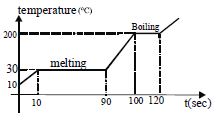
A given mass $m$ of a hypothetical solid is supplied with heat continuously at a constant rate and the graph shown in the adjacent figure is plotted. If $L_f$ and $L_v$ are latent heats of fusion and latent heats of vaporization and $S_l$ and $S_s$ are specific heats of liquid and solid respectively. It can be concluded that 
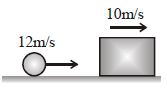
A light particle moving horizontally with a speed of $12\  m/s$ strikes a very heavy block moving in the same direction at $10\  m/s$. The collision is one-dimensional and elastic. After the collision, the particle will
The energy band gap is maximum in
The excess pressure in a soap bubble is double that in other one. The ratio of their volume is $......$
The stopping potential doubles when the frequency of the incident light changes from $v$ to $\frac{3v}{2}$ . Then the work function of the metal must be
A small solid ball is dropped from a height above the free surface of a liquid. It strikes the surface of the liquid at $t = 0$. The density of the material of the ball is $500\  kg/m^3$ and that of liquid is $1000\  kg/m^3$ If the ball comes momeritariiy at rest at $t = 2\  sec$ then initial height of the ball from surface of liquid was ..... $m$ (neglect viscosity)
The nuclear force between two nucleons is explained by
In a $P-$ type semiconductor
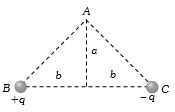
As shown in the figure, charges $ + q$ and $ - q$ are placed at the vertices $B$ and $C$ of an isosceles triangle. The potential at the vertex $A$ is