Question
A photographic plate records sufficiently intense lines when it is exposed for 12s to a source of 10W. How long should it be exposed to a 12W source radiating the light of same colour to get equally intense lines?

Answer

To get equally intense lines on the photographic plate, the radiant flux (energy) should be same. So, 10W × 12sec = 12W × t$\Rightarrow \text{t}=\frac{10\text{W}\times12\text{sec}}{12\text{W}}=10\text{sec.}$

Need a full question paper?

Generate a complete, print-ready paper with questions like this in minutes — across 16+ boards, with answer keys.
Start Generating Free

Similar questions

Estimate the speed of vertically falling raindrops from the following data. Radius of the drops $=0.02 \mathrm{~cm}$, viscosity of air $=1.8 \times 10^{-4}$ poise, $g=9.9 \mathrm{~m} / \mathrm{s}^2$ and density of water $=1000 \mathrm{~kg} / \mathrm{m}^3$.
What are thermal radiations? State their important properties.
When a train starts, the head of a standing passenger seems to be pushed backward. Analyse the situation from the ground frame. Does it really go backward? Coming back to the train frame, how do you explain the backward movement of the head on the basis of Newton's laws?
A circular loop of one turn carries a current of 5.00A. If the magnetic field B at the centre is 0.200mT find the radius of the loop.
Two bar magnets are placed close to each other with their opposite poles facing each other. In absence of other force the magnets are pulled towards each other and their kinetic energy increases. Does it contradict our earher knowledge that magnetic forces cannot do any work and hence cannot increase kinetic energy of a system?
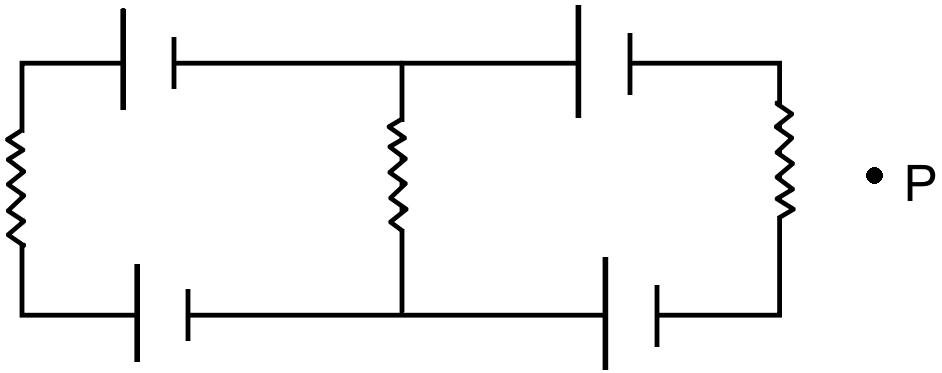
Each of the batteries shown in figure has an emf equal to 5V. Show that the magnetic field B at the point P is zero for any set of values of the resistances.
A hollow spherical body of inner and outer radii 6cm and 8cm respectively floats half submerged in water. Find the density of the material of the sphere.
A woman throws an object of mass 500 g with a speed of $25 \mathrm{~m} \mathrm{~s}^1$.
What is the impulse imparted to the object?
If the velocity of light is taken as the unit of velocity and year as the unit of time, what must be the unit of length? What is it called?
In which of the following examples of motion, can the body be considered approximately a point object: A spinning cricket ball that turns sharply on hitting the ground.