MCQ
A photon will have less energy, if its:
  • A
    Amplitude is higher.
  • B
    Frequency is higher.
  • Wavelength is longer.
  • D
    Wavelength is shorter.

Answer

Correct option: C.
Wavelength is longer.

Need a full question paper?

Generate a complete, print-ready paper with questions like this in minutes — across 16+ boards, with answer keys.
Start Generating Free

Similar questions

An electron with velocity $\vec{v}=\left(v_x \hat{i}+v_y \hat{j}\right)$ moves through a magnetic field $\vec{B}=\left(B_x \hat{i}-B_y \hat{j}\right)$. The force $\overrightarrow{ F }$ on the electron is: ( e is the magnitude of its charge)
The diffusion current in a p-n junction is:
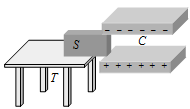
A frictionless dielectric plate S is kept on a frictionless table T. A charged parallel plate capacitance C (of which the plates are frictionless) is kept near it. The plate S is between the plates. When the plate S is left between the plates
A wire in the form of a circular loop of one turn carrying a current produces a magnetic field $B$ at the centre. If the same wire is looped into a coil of two turns and carries the same current, the new value of magnetic induction at the centre is
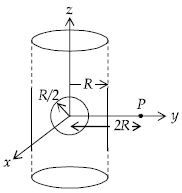
An infinitely long solid cylinder of radius $R$ has a uniform volume charge density $\rho $. It has a spherical cavity of radius $R/2$ with its centre on the axis of the cylinder, as shown in the figure. The magnitude of the electric field at the point $P$, which is at a distance $2R$ from the axis of the cylinder, is given by the expression $\frac{{23\rho R}}{{16K{\varepsilon _0}}}$ .The value of $K$ is
The area of the plates of a parallel plate condenser is A and the distance between the plates is 10 mm. There are two dielectric sheets in it, one of dielectric constant 10 and thickness 6mm and the other of dielectric constant 5 and thickness 4mm. The capacity of the condenser is 
A parallel plate capacitor is charged. Then battery is removed now If the plates are pulled apart
A proton sits at coordinates $(x, y) = (0, 0)$, and an electron at $(d, h)$, where $d >> h$. At time $t = 0$, $a$ uniform electric field $E$ of unknown magnitude but pointing in the positive $y$ direction is turned on. Assuming that $d$ is large enough that the proton-electron interaction is negligible, the $y$ coordinates of the two particles will be equal (at equal time)
What is the order of magnitude of the resistance of a dry human body?
A circular coil having $N\,turns$ and radius $r$ carries a current. It is held in the $XZ$ plane in a magnetic field $B\hat i$ . The torque on the coil due to the magnetic field is