MCQ
A photosensitive substance emits $........$ when illuminated by light:
  • A
    Only protons.
  • B
    Only neutrons.
  • C
    Electrons and protons.
  • Only electrons.

Answer

Correct option: D.
Only electrons.

Need a full question paper?

Generate a complete, print-ready paper with questions like this in minutes — across 16+ boards, with answer keys.
Start Generating Free

Similar questions

Three equal charges $+q$ are placed at the three vertices of an equilateral triangle centred at the origin. They are held in equilibrium by a restoring force of magnitude $F(r)=k r$ directed towards the origin, where $k$ is a constant. What is the distance of the three charges from the origin?
Potential due to charge $q$ at its own location is:
Activity of a radioactive substance is $R_1$ at time $t_1$ and $R_2$ at time $t_2(t_2 > t_1).$ Then the ratio $\frac{R_2}{R_1}$ is :
The half life of a radioactive substance is $20$ minutes. In $........\,minutes$ time,the activity of substance drops to $\left(\frac{1}{16}\right)^{ th }$ of its initial value.
To establish an instantaneous current of $2\,A$ through a $1\,\mu F$ capacitor ; the potential difference across the capacitor plates should be changed at the rate of
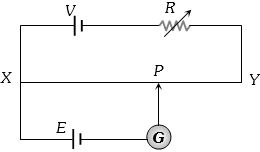
A potentiometer circuit shown in the figure is set up to measure $e.m.f.$ of a cell $E$. As the point $P$ moves from $X$ to $Y$ the galvanometer $G$ shows deflection always in one direction, but the deflection decreases continuously until $Y$ is reached. In order to obtain balance point between $X$ and $Y$ it is necessary to
Two similar bar magnets P and Q, each of magnetic moment M, are taken, If P is cut along its axial line and Q is cut along its equatorial line, all the four pieces obtained have
A metal exposed to light of wavelength $800\,nm$ and emits photoelectrons with a certain kinetic energy. The maximum kinetic energy of photo-electron doubles when light of wavelength $500\, nm$ is used. The work function of the metal is $...eV$ (Take $hc =1230 \,eV - nm$ ).
The size of the nucleus is approximately :
A plane mirror is placed $22.5\;cm$ in front of a concave mirror of focal length $10\;cm$. An object can be placed between the two mirrors so that the first image in both the mirror coincides. The object distance from the spherical mirror is