MCQ
A physical quantity which has a direction
  • A
    must be a vector
  • B
    may be a vector
  • may be both scalar and vector
  • D
    none of the above

Answer

Correct option: C.
may be both scalar and vector
c
Time, pressure, surface tension, current, etc, are some such physical quantities which have direction but are not vectors. Hence, a physical quantity having a direction may or may not be a vector.

Need a full question paper?

Generate a complete, print-ready paper with questions like this in minutes — across 16+ boards, with answer keys.
Start Generating Free

Similar questions

The maximum current that can be measured by a galvanometer of resistance $40 \,\Omega$ is $10\, mA$. It is converted into a voltmeter that can read upto $50\, V$. The resistance to be connected in series with the galvanometer is ... (in $ohm$)
An aeroplane flies $400 \,m$ north and $300 \,m$ south and then flies $1200 \,m$ upwards then net displacement is...........$m$
The binding energy of deuteron $_1^2H\,\,$ is $\,\,1.112\,\,MeV$  per nucleon and an $\alpha- $ particle $_2^4He$ has a binding energy of  $7.047\,\,MeV$  per nucleon. Then in the fusion reaction ${}_1^2H\, + \,{}_1^2H\, \to \,{}_2^4He\, + \,Q,$  the energy  $Q$ released is ........... $MeV$
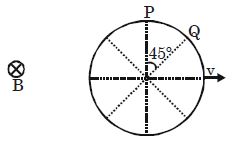
A conducting ring of radius $R$ is placed in uniform inward magnetic field $\vec B$ as shown. If ring is moving with velocity $\vec v$ in its plane, the induced $emf$ across arc $PQ$ will be 
A solid disc of radius $20 \,{cm}$ and mass $10\, {kg}$ is rotating with an angular velocity of $600\, {rpm}$, about an axis normal to its circular plane and passing through its centre of mass. The retarding torque required to bring the disc at rest in $10\, {s}\, ......\, \pi \times \,10^{-1}\, {Nm}$.
$A$ straight line joining the object point and image point is always perpendicular to the mirror
Proton $(P)$ and electron $(e)$ will have same deBroglie wavelength when the ratio of their momentum is (assume, $m _{ p }=1849\,m _{ e }$)
The ratio of inertial mass and gravitational mass has been found to be $1$ for all material bodies. Were this ratio different for different bodies, the two bodies having same gravitational mass but different inertial mass would have?
A particle of specific charge $(q/m)$ is projected from the origin of coordinates with initial velocity $[ui - vj]$. Uniform electric magnetic fields exist in the region along the $+y$ direction, of magnitude $E$ and $B.$ The particle will definitely return to the origin once if
A uniform wire of resistance $9$ $\Omega$ is cut into $3$ equal parts. They are connected in the form of equilateral triangle $ABC$. A cell of $e.m.f.$ $2\,V$ and negligible internal resistance is connected across $B$ and $C$. Potential difference across $AB$ is ............... $V$