MCQ
A physical quantity which has a direction
  • A
    must be a vector
  • B
    may be a vector
  • may be both scalar and vector
  • D
    none of the above

Answer

Correct option: C.
may be both scalar and vector
c
Time, pressure, surface tension, current, etc, are some such physical quantities which have direction but are not vectors. Hence, a physical quantity having a direction may or may not be a vector.

Need a full question paper?

Generate a complete, print-ready paper with questions like this in minutes — across 16+ boards, with answer keys.
Start Generating Free

Similar questions

Two sound sources emitting sound each of wavelength $\lambda$ are fixed at a given distance apart. A listener moves with a velocity u along the line joining the two sources. The number of beats heard by him per second is:
If the volume of the given mass of a gas is increased four times, the temperature is raised from $27°C$ to $127°C.$ The elasticity will become
A train has a speed of $60\, km/h$. for the first one hour and $40\, km/h $ for the next half hour. Its average speed in $km/h$ is
The key property of fluids is that:
The resultant amplitude due to superposition of two waves $y_1 = 5\,\,sin (wt - kx)$ and $y_2 = -5 \,\,cos (wt - kx - 150^o)$
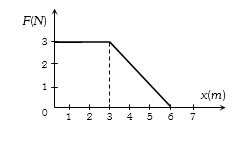
A force $F$ acting on an object varies with distance $x$as shown here. The force is in newton and $x$ in metre. The work done by the force in moving the object from $x = 0$to $x = 6\,m$ is......$J$
Match the thermodynamic processes taking place in a system with the correct conditions. In the table: $\Delta Q$ is the heat supplied, $\Delta W$ is the work done and $\Delta U$ is change in internal energy of the system
Process Condition
$(I)$ Adiabatic $(A)\; \Delta W =0$
$(II)$ Isothermal $(B)\; \Delta Q=0$
$(III)$ Isochoric $(C)\; \Delta U \neq 0, \Delta W \neq 0 \Delta Q \neq 0$
$(IV)$ Isobaric $(D)\; \Delta U =0$
A sealed container with negligible thermal coefficient of expansion contains helium (a monoatomic gas). When it is heated from 300 to 600K, the average kinetic energy of the helium atom is:
A light rod of length $l$ has two masses $m_1$ and $m_2$ attached to its two ends. The moment of inertia of the system about an axis perpendicular to the rod and passing through the centre of mass is 
An angular impulse of $20 \,Nms$ is applied to a hollow cylinder of mass $2 \,kg$ and radius $20 \,cm$. The change in its angular speed is ............. $rad / s$