A piece of glass is heated to a high temperature and then allowed to cool. If it cracks, a probable reason for this is the following property of glass
Easy
Download our app for free and get started
(a)When a piece of glass is heated, due to low thermal conductivity it does not conduct heat fast. Hence unequal expansion of it’s layers crack the glass.

Download our appand get started for free
Experience the future of education. Simply download our apps or reach out to us for more information. Let's shape the future of learning together!No signup needed.*
Similar Questions
- 1Two metal spheres have radil $r$ and $2 r$ and they emit thermal radiation with maximum intensities at wavelengths $\lambda$ and $2 \lambda$ respectively. The respective ratio of the radiant energy emitted by them per second will be .........View Solution
- 2A bowl filled with very hot soup cools from $98^{\circ}\,C$ to $86^{\circ}\,C$ in $2$ minutes when the room temperature is $22^{\circ}\,C$. $..........\,minutes$ long it will take to cool from $75^{\circ}\,C$ to $69^{\circ}\,C$ ?View Solution
- 3A black body at $1227^o C$ emits radiations with maximum intensity at a wavelength of $5000\;\mathring A$ . If the temperature of the body is increased by $1000^o C$, the maximum intensity will be observed at ...... $\mathring A$View Solution
- 4Three stars $A, B, C$ have surface temperatures $T _{A} ,T _{B}, T _{C}$ respectively. Star $A$ appears bluish, star $B$ appears reddish and star $C$ yellowish. Hence,View Solution
- 5A container with $1 kg$ of water in it is kept in sunlight, which causes the water to get warmer than the surroundings. The average energy per unit time per unit area received due to the sunlight is $700 Wm ^{-2}$ and it is absorbed by the water over an effective area of $0.05 m ^2$. Assuming that the heat loss from the water to the surroundings is governed by Newton's law of cooling, the difference (in ${ }^{\circ} C$ ) in the temperature of water and the surroundings after a long time will be. . . . . . . . (Ignore effect of the container, and take constant for Newton's law of cooling $=0.001 s ^{-1}$, Heat capacity of water $\left.=4200 J kg ^{-1} K ^{-1}\right)$View Solution
- 6A black body at a temperature of $1640\,\,K$ has the wavelength corresponding to maximum emission equal to $1.75 \,\,\mu m.$ Assuming the moon to be a perfectly black body, the temperature of the moon, if the wavelength corresponding to maximum emission is $14.35\,\,\mu m$ is.......$K$View Solution
- 7Assertion : The equivalent thermal conductivity of two plates of same thickness in contact is less than the smaller value of thermal conductivity.View Solution
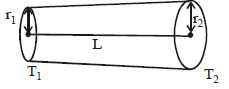
Reason : For two plates of equal thickness in contact the equivalent thermal conductivity is given by : $\frac{1}{K} = \frac{1}{{{K_1}}} + \frac{1}{{{K_2}}}$ - 8The rate of heat flow through the cross-section of the rod shown in figure is ($T_2 > T_1$ and thermal conductivity of the material of the rod is $K$)View Solution
- 9A room is maintained at ${20^o}C$ by a heater of resistance $20$ ohm connected to $200$ volt mains. The temperature is uniform through out the room and heat is transmitted through a glass window of area $1{m^2}$ and thickness $0.2$ cm. What will be the temperature outside ....... $^oC$ ? Given that thermal conductivity $K=0.2$ for glass is and $J = 4.2 J/cal$View Solution
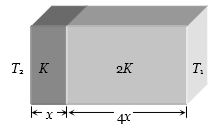
- 10The temperature of the two outer surfaces of a composite slab, consisting of two materials having coefficients of thermal conductivity $K$ and $2K$ and thickness $x$ and $4x$ , respectively are $T_2$ and $T_1$ ($T_2$ > $T_1$). The rate of heat transfer through the slab, in a steady state is $\left( {\frac{{A({T_2} - {T_1})K}}{x}} \right)f$, with $f $ which equal toView Solution