MCQ
A pipe $30\, cm$ long, is open at both ends. Which harmonic mode of the pipe resonates a $1.1\, kHz$ source ? (Speed of sound in air $= 330\, ms^{-1}$)
  • A
    $1$
  • $2$
  • C
    $3$
  • D
    $4$

Answer

Correct option: B.
$2$
b
Here,

Speed of sound, $\mathrm{v}=330 \mathrm{\,ms}^{-1}$

Length of pipe, $\mathrm{L}=30 \mathrm{\,cm}=30 \times 10^{-2} \mathrm{\,m}$

In a open pipe (open at both ends), the frequency of its $n^{\text {th }}$ harmonic is

$v_{n}=\frac{n v}{2 L}$ where $n=1,2,3........$

$\therefore \mathrm{n}=\frac{2 \mathrm{L} v_{\mathrm{n}}}{\mathrm{v}}$

Let $n^{\text {th }}$ harmonic of open pipe resonate with $1.1$ $\mathrm{\,kHz}$ source.

$\therefore \mathrm{v}_{\mathrm{n}}=1.1 \mathrm{\,kHz}=1.1 \times 10^{3} \mathrm{\,Hz}$

$\therefore \mathrm{n}=\frac{2 \times 30 \times 10^{-2} \times 1.1 \times 10^{3}}{330}=2$

Need a full question paper?

Generate a complete, print-ready paper with questions like this in minutes — across 16+ boards, with answer keys.

Start Generating Free

Similar questions

$Assertion :$ For the formation of stationary waves the medium must be bounded having definite boundaries.
$Reason :$ In the stationary wave, some particles of the medium remain permanently at rest.
A composite rod made of three rods of equal length and cross-section as shown in the fig. The thermal conductivities of the materials of the rods are $K/2, 5K$ and $K$ respectively. The end $A$ and end $B$ are at constant temperatures. All heat entering the face Agoes out of the end $B$ there being no loss of heat from the sides of the bar. The effective thermal conductivity of the bar is
The initial pressure and volume of an ideal gas are $P_0$ and $V_0$. The final pressure of the gas when the gas is suddenly compressed to volume $\frac{ V _0}{4}$ will be (Given $\gamma=$ ratio of specific heats at constant pressure and at constant volume)
A point object O is placed on the principal axis of a convex lens of focal length f = 20cm at a distance of 40cm to the left of it. The diameter of the lens is 10cm. An eye is placed 60cm to right of the lens and a distance h below the principal axis. The maximum value of h to see the image is:
A charged particle moves along a circle under the action of possible constant electric and magnetic fields. Which of the following are possible?
The magnitude of pairs of displacement vectors are given. Which pair of displacement  vectors cannot be added to give a resultant vector of magnitude $13\, cm$?
If $x = a -b,$ then percentage error in $x$ will be
A rod of mass $‘M’$ and length $‘2L’$ is suspended at its middle by a wire. It exhibits torsional oscillations; If two masses each of $‘m’$ are attached at distance $‘L/2’$ from its centre on both sides, it reduces the oscillation frequency by $20\%$. The value of ratio $m/M$ is close to
The ratio of densities of nitrogen and oxygen is $14:16.$ The temperature at which the speed of sound in nitrogen will be same at that in oxygen at $55^oC$ is  ..... $^oC$
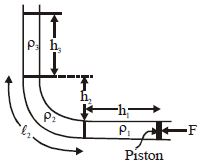
A tube is bent into $L$ shape and kept in a vertical plane. If these three liquids are kept in equilibrium by the piston of area $A$ , the value of $\frac {F}{A}$ is