Question
A plane electromagnetic wave is passing through a region. Consider (a) electric field (b) magnetic field (c) electrical energy in a small volume and (d) magnetic energy in a small volume. Construct the pairs of the quantities that oscillate with equal frequencies.
Answer

Let the electromagnetic wave be propagating in the z-direction. The vibrations of the electric and magnetic fields are given by,

$\text{E}_\text{x}=\text{E}_0\sin(\text{kz}-\omega\text{t})$

$\text{B}_\text{y}=\text{B}_0\sin(\text{kz}-\omega\text{t})$

Let the volume of the region be V.

The angular frequency of the vibrations of the electric and magnetic fields are same and are equal to $\omega$

Therefore, their frequency, $\text{f}=\frac{\omega}{2\pi},$ is same.

The electrical energy in the region,

$\text{U}_\text{E}=\Big(\frac{1}{2}\in_0\text{E}^2\Big)\times\text{V}$

It can be written as,

$\text{U}_\text{E}=\Big(\frac{1}{2}\in_0\big(\text{E}^2_0\sin^2(\text{kz}-\omega\text{t})\big)\Big)\times\text{V}$

$\text{U}_\text{E}=\Bigg(\frac{1}{2}\in_0\text{E}_0^2\times\frac{\big(1-\cos2(\text{kz}-\omega\text{t})\big)}{2}\Bigg)\times\text{V}$

$\text{U}_\text{E}=\Big(\frac{1}{4}\in_0\text{E}_0^2\times(1-\cos2(\text{kz}-\omega\text{t}))\Big)\times\text{V}$

The magnetic energy in the region,

$\text{U}_\text{B}=\Big(\frac{\text{B}^2}{2\mu_0}\Big)\times\text{V}$

$\text{U}_\text{B}=\bigg(\frac{\text{B}^2_0\sin^2(\text{kz}-\omega\text{t})}{2\mu_0}\bigg)\times\text{V}$

$\text{U}_\text{B}=\Bigg(\frac{\text{B}^2_0\big(1-\cos(2\text{kz}-2\omega\text{t})\big)}{4\mu_0}\Bigg)\times\text{V}$

The angular frequency of the electric and magnetic is same and is equal to $2\omega$

Therefore, their frequency,

$\text{f}'=\frac{2\omega}{2\pi}=2\text{f}$

Will be same.

Thus, the electric and magnetic fields have same frequencies and the electrical and magnetic energies will have same frequencies.

Need a full question paper?

Generate a complete, print-ready paper with questions like this in minutes — across 16+ boards, with answer keys.

Start Generating Free

Similar questions

Suppose the $19\Omega$ resistor of the previous problem is disconnected. Find the current through P2Q2 in the two situations:
  1. Both the wires move towards right.
  2. If P1Q1 moves towards left but P2Q2 moves towards right.
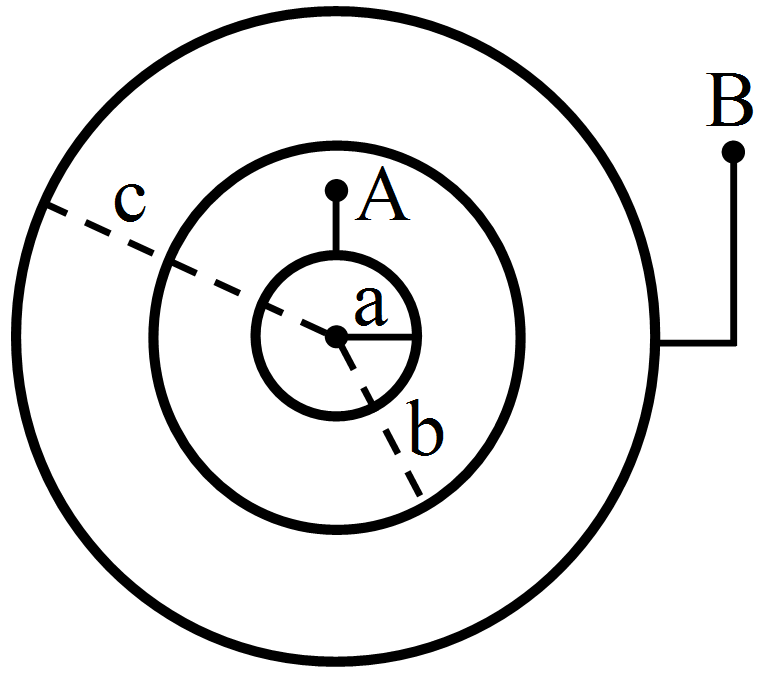
Consider an assembly of three conducting concentric spherical shells of radii a, b and c as shown in figure. Find the capecitance of the assembly between the poima A and B

Consider the situation shown in the figure of the previous problem. Suppose the wire connecting O and C has zero resistance but the circular loop has a resistance R uniformly distributed along its length. The rod OA is made to rotate with a uniform angular speed $\omega$ shown in the figure. Find the current in the rod when $\angle\text{AOC}=90^{\circ}$
Two metre scales, one of steel and the other of aluminium, agree at 20°C. Calculate the ratio aluminium-centimetre/ steel-centimetre at:
  1. 0°C,
  2. 40°C
  3. 100C. $\alpha$ for steel = 1.1 × 10-5 °C-1 and for aluminium= 2.3 × 10⁻⁵ °C-1.
Answer the following the questions.
  1. A small compass needle of magnetic moment ‘m’ is free to turn about an axis perpendicular to the direction of uniform magnetic field ‘B’. The moment of inertia of the needle about the axis is ‘I’. The needle is slightly disturbed from its stable position and then released. Prove that it executes simple harmonic motion. Hence deduce the expression for its time period.
  2. A compass needle, free to turn in a vertical plane orients itself with its axis vertical at a certain place on the earth. Find out the values of (i) horizontal component of earth’s magnetic field and (ii) angle of dip at the place.
In an imaginary atmosphere, the air exerts a small force F on any particle in the direction of the particle's motion. A particle of mass m projected upward takes a time t1 in reaching the maximum height and t2 in the return journey to the original point. Then:
  1. t1 < t2
  2. t1 > t2
  3. t1 = t2
  4. The relation between t1 and t2 depends on the mass of the particle.
Figure shows a plane mirror M placed at a distance of 10cm from a concave lens L. A point object is placed at a distance of 60cm from the lens. The image formed due to refraction by the lens and reflection by the mirror is 30cm behind the mirror. What is the focal length of this lens?
A point charge causes an electric flux of –1.0 × 10³ Nm2 /C to pass through a spherical Gaussian surface of 10.0 cm radius centred on the charge.
  1. If the radius of the Gaussian surface were doubled, how much flux would pass through the surface?
  2. What is the value of the point charge?
Two ideal gases have the same value of $\frac{\text{C}_\text{P}}{\text{C}_\text{V}}=\gamma.$ What will be the value of this ratio for a mixture of the two gases in the ratio 1 : 2?