MCQ
A plane electromagnetic wave with a single frequency moves in vacuum in the positive x direction. Its amplitude is uniform over the yz plane. the amplitude of its magnetic field.
  • A
    Increase
  • B
    Decrease
  • same
  • D
    None

Answer

Correct option: C.
same

The same amount of energy passes through equal areas parallel to the $yz$ plane as the wave travels in the $+x$ direction, so the amplitude and the intensity, which is proportional to the square of the amplitude, do not change.

Need a full question paper?

Generate a complete, print-ready paper with questions like this in minutes — across 16+ boards, with answer keys.
Start Generating Free

Similar questions

The difference in the lengths of a mean solar day and a sidereal day is about
Which one of the following is known as Saptarishi
Assertion : The electron in the hydrogen atom passes from energy level n = 4 to the n = 1 level. The maximum and minimum number of photon that can be emitted are six and one respectively.
Reason : The photons are emitted when electron make a transition from the higher energy state to the lower energy state.
The chromatic Aberration in lenses becomes due to
If the resistance of a conductor is $5 W$ at $50^{\circ} \mathrm{C}$ and $7 W$ at $100^{\circ} \mathrm{C}$ then the mean temperature coefficient of resistance of the material is
 
Select the correct alternative 
Three capacitors each of capacitance $1\,\mu F$ are connected in parallel. To this combination, a fourth capacitor of capacitance $1\,\mu F$ is connected in series. The resultant capacitance of the system is.......$\mu F$
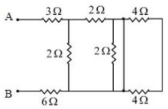
In the given circuit, the equivalent resistance between the terminal $A$ and $B$ is $........\Omega$.
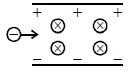
An electron enters the space between the plates of a charged capacitor as shown. The charge density on the plate is $\sigma $. Electric intensity in the space between the plates is $E$. A uniform magnetic field $B$ also exists in that space perpendicular to the direction of $E$. The electron moves perpendicular to both $\vec E$ and $\vec B$ without any change in direction. The time taken by the electron to travel a distance $\ell $ is the space is
An electron is projected with uniform velocity along the axis of a current carrying long solenoid. Which of the following is true?