Question
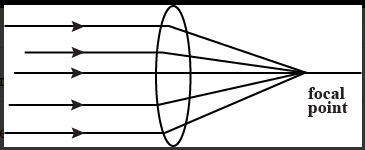
A plane wave front falls on a convex lens. The emergent wave front is:

Answer

  1. Spherical converging
Explanation:
A convex lens is thicker at the middle. When a light ray is incident parallel
to principle axis it is refracted towards the focal point. Similarly when a plane wave front is incident on a convex lens the light is refracted towards a point on the focal plane.
As the light is getting focused at a point it is converging and the emerging wave front is a spherical converging.

Need a full question paper?

Generate a complete, print-ready paper with questions like this in minutes — across 16+ boards, with answer keys.
Start Generating Free

Similar questions

A constant current of 2.8A exists in a resistor. The rms current is:
  1. 2.8A.
  2. About 2A.
  3. 1.4A.
  4. Undefined for a direct current.
Two statements are given-one labelled Assertion (A) and the other labelled Reason (R). Select the correct answer to these questions from the codes (a), (b), (c) and (d) as given below.
Assertion (A): The kinetic energy of a charged particle moving in a uniform magnetic field does not change. Reason (R): In a uniform magnetic field no force acts on the charge particle.
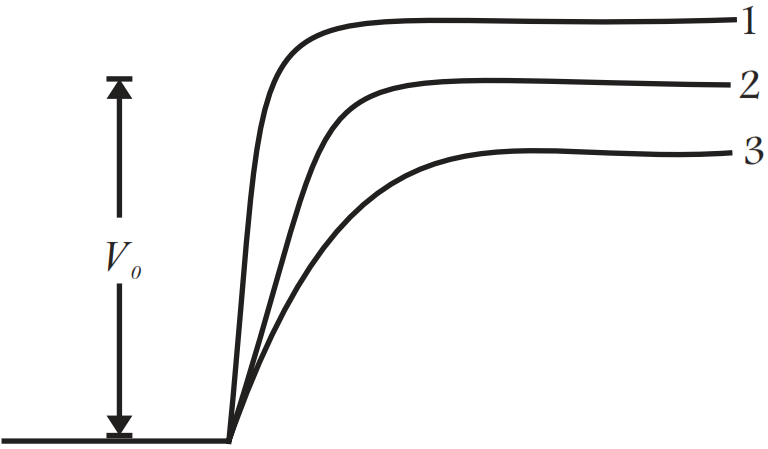
In Fig $,Vo$ is the potential barrier across a $p-n$ junction, when no battery is connected across the junction :
The period of oscillations of a magnetic needle in a magnetic field is 1.0 sec. If the length of the needle is halved by cutting it, the time period will be(a) 1.0 sec(b) 0.5 sec(c) 0.25 sec(d) 2.0 sec
       
Curie is a unit of(a) Length(b) It is not any unit(c) Activity(d) Atomic number
       
To compare magnetic moments of two magnets by vibration magnetometer, 'sum and difference method' is better because(a) Determination of moment of inertia is not needed which minimises the errors(b) Less observations are required(c) Comparatively less calculations(d) All the above


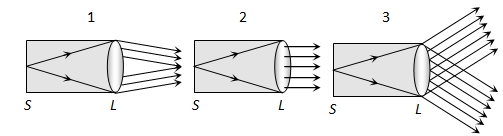
The slit of a collimator is illuminated by a source as shown in the adjoining figures. The distance between the slit $S$ and the collimating lens $L$ is equal to the focal length of the lens. The correct direction of the emergent beam will be as shown in figure
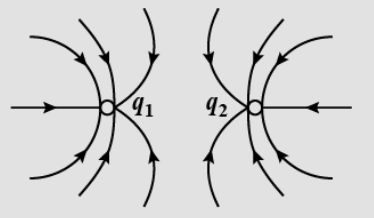
Identify the correct statement about the charges $q_{1​}$ and $q_{2}$
In the series combination of two or more than two resistances:
Two identical conductors of copper and aluminium are placed in an identical electric fields. The magnitude of induced charge in the aluminium will be(a) Zero  (b) Greater than in copper(c) Equal to that in copper(d) Less than in copper