MCQ
A planet revolves around sun whose mean distance is $1.588$ times the mean distance between earth and sun. The revolution time of planet will be ........... $ years$
  • A
    $1.25$
  • B
    $1.59$
  • C
    $0.89$
  • $2$

Answer

Correct option: D.
$2$
d
(d)$\frac{{{T_{{\rm{plant}}}}}}{{{T_{{\rm{earth}}}}}} = {\left( {\frac{{{r_{{\rm{plant}}}}}}{{{r_{{\rm{earth}}}}}}} \right)^{3/2}} = {(1.588)^{3/2}} = 2$
${T_{{\rm{planet}}}} = 2\;year$

Need a full question paper?

Generate a complete, print-ready paper with questions like this in minutes — across 16+ boards, with answer keys.

Start Generating Free

Similar questions

The correct figure that shows, schematically, the wave pattern produced by superposition of two waves of frequencies $9\,Hz$ and $11\,Hz,$
A perfect gas goes from state $A$ to another state $B$ by absorbing $8 \times {10^5}J$ of heat and doing $6.5 \times {10^5}J$ of external work. It is now transferred between the same two states in another process in which it absorbs ${10^5}J$ of heat. Then in the second process
The resultant of the two vectors having magnitude $2$ and $3$ is $1$. What is their cross product
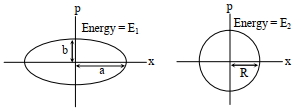
Two independent harmonic oscillators of equal mass are oscillating about the origin with angular frequencies $\omega_1$ and $\omega_2$ and have total energies $E_1$ and $E_2$, respectively. The variations of their momenta $p$ with positions $x$ are shown in the figures. If $\frac{a}{b}= n ^2$ and $\frac{ a }{ R }= n$, then the correct equation$(s)$ is(are) $Image$

$(A)$ $E_1 \omega_1=E_2 \omega_2$ $(B)$ $\frac{\omega_2}{\omega_1}=n^2$ $(C)$ $\omega_1 \omega_2= n ^2$ $(D)$ $\frac{E_1}{\omega_1}=\frac{E_2}{\omega_2}$
The photocurrent in an experiment on photoelectric effect increases if:
  1. The intensity of the source is increased.
  2. The exposure time is increased.
  3. The intensity of the source is decreased.
  4. The exposure time is decreased.
A cyclist turns around a curve at $15\, miles/hour$. If he turns at double the speed, the tendency to overturn is
Force (F) and density (d) are related as $\text{F}=\frac{\alpha}{\beta+\sqrt{\text{d}}}$
Then, the dimensions of a and B are:
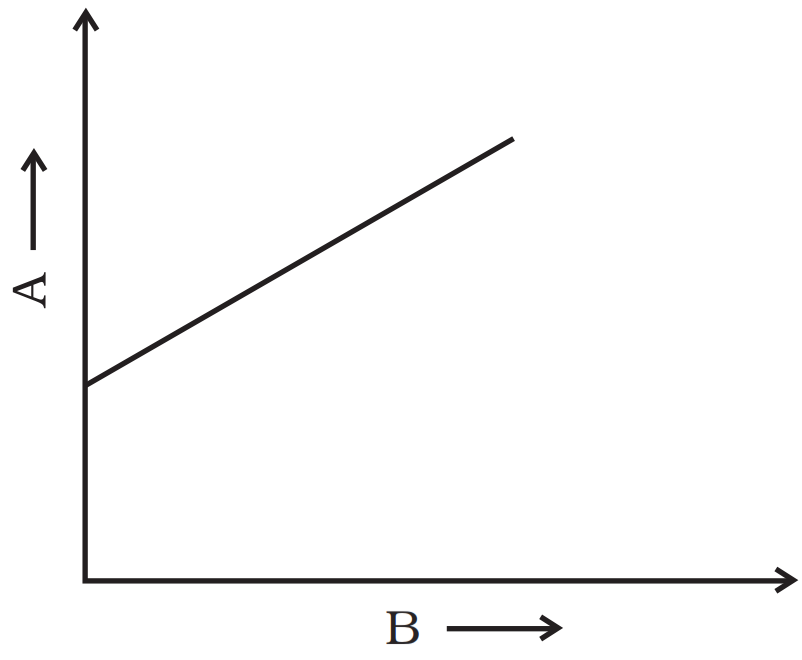
The variation of quantity A with quantity B, plotted in Fig. describes the motion of a particle in a straight line.

Consider a collision between an oxygen molecule and a hydrogen molecule in a mixture of oxygen and hydrogen kept at room temperature. Which of the following are pcssible?
A ball thrown by one player reaches the other in $2\, sec$. The maximum height attained by the ball above the point of projection will be about .......... $m$