MCQ
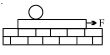
$A$ plank with a uniform sphere placed on it rests on a smooth horizontal plane. Plank is pulled to right by $a$ constant force $F$. If sphere does not slip over the plank. Which of the following is incorrect.
  • A
    Acceleration of the centre of sphere is less than that of the plank.
  • B
    Work done by friction acting on the sphere is equal to its total kinetic energy.
  • C
    Total kinetic energy of the system is equal to work done by the force $F$
  • None of the above

Answer

Correct option: D.
None of the above
d

Need a full question paper?

Generate a complete, print-ready paper with questions like this in minutes — across 16+ boards, with answer keys.

Start Generating Free

Similar questions

The energy stored in a $50 \,mH$ inductor carrying a current of $4 \,A$ will be....$J$
A copper rod $2\,m$ long has a circular cross-section of radius $1\, cm$. One end is kept  at $100^o\,C$ and the other at $0^o\,C$ and the surface is covered by nonconducting material to check the heat losses through the surface. The thermal  resistance of the bar in degree kelvin per watt is (Take thermal conductivity $K = 401\, W/m-K$ of copper):-
Quantam nature of light is explained by which of the following phenomenon
The momentum is most closely related to
Density of rubber is $​d$​. $​ A$​ thick rubber cord of length $​L$​ and cross-section area $​A$​ undergoes elongation under its own weight on suspending it. This elongation is proportional to
A proton and an $\alpha$ -particle are accelerated from rest to the same energy. The de Broglie wavelengths $\lambda_{\mathrm{p}}$ and $\lambda_{\alpha}$ are in the ratio,
The particles $A$ and $B$ of mass $m$ each are separated by a distance $r$. Another particle $C$ of mass $M$ is placed at the midpoint of $A$ and $B$. Find the work done in taking $C$ to a point equidistant $r$ from $A$ and $B$ without acceleration $(G=$ Gravitational constant and only gravitational interaction between $A, B$ and $C$ is considered) 
The phase difference between the two particles situated on both the sides of a node is ... $^o$
Consider a cube of uniform charge density $\rho$. The ratio of electrostatic potential at the centre of the cube to that at one of the corners of the cube is
Two slits, $4 \,mm$ apart, are illuminated by light of wavelength $6000 Å$. What will be the fringe width on a screen placed $2\,m$ from the slits.....$mm$