MCQ
A planoconvex lens, when silvered at its plane surface is equivalent to a concave mirror of focal length $28\,cm$. When its curved surface is silvered and the plane surface is not silvered, it is equivalent to a concave mirror of focal length $10\,cm$, then the refractive index of the material of the lens is
  • A
    $\frac {9}{14}$
  • $\frac {14}{9}$
  • C
    $\frac {17}{9}$
  • D
    None of these

Answer

Correct option: B.
$\frac {14}{9}$
b
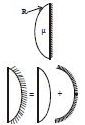
lens $+$ mirror $ \to $ mirror

$\frac{1}{{{f_L}}} = \frac{1}{{{f_m}}} - \frac{2}{{{f_l}}}$

${f_m} \to \infty $

$\frac{1}{{{f_l}}} = \left( {\mu  - 1} \right)\left( {\frac{1}{R} - \frac{1}{\infty }} \right)$

$\frac{1}{{{f_l}}} = \frac{{\mu  - 1}}{R}$

$\frac{1}{{{f_l}}} = \frac{R}{{\mu  - 1}}$

${f_m} = \frac{{ - fl}}{2} = \frac{{ - R}}{{2\left( {\mu  - 1} \right)}}$

Given that $\frac{R}{{2\left( {\mu  - 1} \right)}} = 28$       ...........$(1)$

$\frac{1}{{{f_l}}} = \left( {\mu  - 1} \right)\left( {\frac{1}{\infty } - \frac{1}{{ - R}}} \right)$

$\frac{1}{{{f_l}}} = \frac{{\mu  - 1}}{R}$

${f_m} = \frac{{ - R}}{2}$

$\frac{1}{{{f_F}}} = \frac{1}{{{f_m}}} - \frac{2}{{{f_l}}}$

$\frac{1}{{{f_m}}} = \frac{2}{R} - \frac{{2\left( {\mu  - 1} \right)}}{R}$

${f_F} = 10\,\,cm$

$\frac{2}{R} + \frac{{2\left( {\mu  - 1} \right)}}{R} = \frac{1}{{10}}$

$\frac{{2\mu }}{R} = \frac{1}{{10}}$             ..........$(2)$

$R = 20\mu $

$\frac{{20\mu }}{{2\left( {2\mu  - 1} \right)}} = 28$

$\mu  = 2.8\left( {\mu  - 1} \right)$

$\mu  = 2.8\mu  - 2.8$

$\mu \frac{{2.8}}{{1.8}} = \frac{{14}}{9}$
Need a full question paper?

Generate a complete, print-ready paper with questions like this in minutes — across 16+ boards, with answer keys.

Start Generating Free

Similar questions

A particle moves from position $3\hat i + 2\hat j - 6\hat k$ to $14\hat i + 13\hat j + 9\hat k$ due to a uniform force of $(4\hat i + \hat j + 3\hat k)\,N.$ If the displacement in meters then work done will be.........$J$
In series $LR$ circuit $X_L = 3R$. Now a capacitor with $X_C = R$ is added in series. Ratio of new to old power factor is 
A proton (or charged particle) moving with velocity $v$ is acted upon by electric field $E$ and magnetic field $B$. The proton will move undeflected if
The variation of wavelength $\lambda $ of the ${K_\alpha }$ line with atomic number $Z$ of the target is shown by the following curve of
The capacity and the energy stored in a parallel plate condenser with air between its plates are respectively ${C_o}$ and ${W_o}$. If the air is replaced by glass (dielectric constant $= 5$ ) between the plates, the capacity of the plates and the energy stored in it will respectively be
The focal length of objective and eye lens of a microscope are $4\, cm$ and $8\, cm$ respectively. If the least distance of distinct vision is $24 \,cm$ and object distance is $4.5 \,cm$ from the objective lens, then the magnifying power of the microscope will be
A radioactive sample $\mathrm{S} 1$ having an activity $5 \mu \mathrm{Ci}$ has twice the number of nuclei as another sample $\mathrm{S} 2$ which has an activity of $10 \mu \mathrm{Ci}$. The half lives of $\mathrm{S} 1$ and $\mathrm{S} 2$ can be
A current of $200 \mu A$ deflects the coil of a moving coil galvanometer through $60^{\circ}$. The current to cause deflection through $\frac{\pi}{10}$ radian is :
Which of the following statements is true about the flow of electrons in an electric circuit?
The internal resistance of a cell is the resistance of