Question
A point charge is moving along a straight line with a constant velocity u. Consider a small area A perpendicular to the direction of motion of the charge (El). Calculate the displacement current through the area when its distance from the charge is x. The value of x is not large so that the electric field at any instant is essentially given by Coulomb's law.

Answer

$\text{E}=\frac{\text{Kq}}{\text{x}^2}$ [from coulomb's law]
$\phi_\text{E}=\text{EA}=\frac{\text{KqA}}{\text{x}^2}$
$\text{l}_\text{d}=\in_0\frac{\text{d}\phi\text{E}}{\text{dt}}=\in_0\frac{\text{d}}{\text{dt}}\frac{\text{kqA}}{\text{x}^2}=\in_0\text{KqA}=\frac{\text{d}}{\text{dt}}\text{x}^{-2}$
$=\in_0\times\frac{1}{4\pi\in_0}\times\text{q}\times\text{A}\times-2\times\text{x}^{-3}\times\frac{\text{dx}}{\text{dt}}=\frac{\text{qAv}}{2\pi\text{x}^3}$

Need a full question paper?

Generate a complete, print-ready paper with questions like this in minutes — across 16+ boards, with answer keys.

Start Generating Free

Similar questions

Two identical coherent waves, each of intensity I, are producing an interference pattern. Find the value of the resultant intensity at a point of:
  1. Constructive interference.
  2. Destructive interference.
Obtain the de Broglie wavelength associated with thermal neutrons at room temperature (27ºC). Hence explain why a fast neutron beam needs to be thermalised with the environment before it can be used for neutron diffraction experiments.
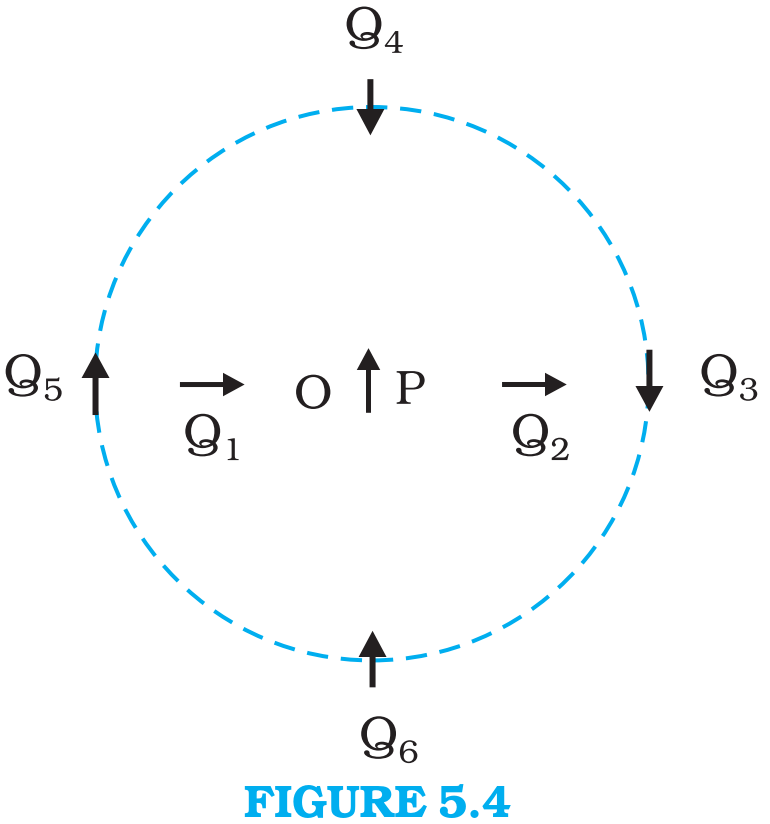
Figure 5.4 shows a small magnetised needle $P$ placed at a point $O$. The arrow shows the direction of its magnetic moment. The other arrows show different positions (and orientations of the magnetic moment) of another identical magnetised needle $Q$.
(a) In which configuration the system is not in equilibrium?
(b) In which configuration is the system in (i) stable, and (ii) unstable equilibrium?
(c) Which configuration corresponds to the lowest potential energy among all the configurations shown?
Image
Identify the following electromagnetic radiations as per the wavelengths given below.
  1. $10^{-3}nm$
  2. $10^{-3}m$
  3. 1nm
Write one application of each.
The time taken by Mars to revolve round the sun is 1.88 years. Find the ratio of average distance between Mars and the sun to that between the earth and the sun.
  1. Obtain the expression for the cyclotron frequency.
  2. A deuteron and a proton are accelerated by the cyclotron. Can both be accelerated with the same oscillator frequency? Give reason to justify your answer.
A circular loop of radius r carries a current i. How should a long, straight wire carrying a current 4i be placed in the plane of the circle so that the magnetic field at the centre becomes zero?
A point object is placed on the principal axis of a convex lens (f = 15cm) at a distance of 30cm from it. A glass plate $(\mu=1.50)$ of thickness 1cm is placed on the other side of the lens perpendicular to the axis. Locate the image of the point object.
A particle is subjected to two simple harmonic motions, one along the X-axis and the other on a line making an angle of 45° with the X-axis, The two motions are given by,$\text{x}=\text{x}_0\sin\omega\text{t}$ and $\text{s}=\text{s}_0\sin\omega\text{t}$
Find the amplitude of the resultant motion.
The current in a long solenoid of radius R and having n turns per unit length is given by $\text{i}=\text{i}_0\sin\omega\text{t}.$ A coil having N turns is wound around it near the centre. Find
  1. The induced emf in the coil.
  2. The mutual inductance between the solenoid and the coil.