Question
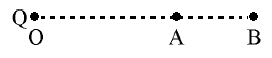
A point charge Q is placed at point O as shown in the figure. The potential difference VA – VB positive. Is the charge Q negative or positive?
Answer

VA - VB > 0.

Need a full question paper?

Generate a complete, print-ready paper with questions like this in minutes — across 16+ boards, with answer keys.
Start Generating Free

Similar questions

Can X-rays be polarized?
The ratio between flux binding and current I passing through a coil of N turns is called $\left(\frac{ N \phi}{2}\right)$
The graph shows the variation of stopping potential with frequency of incident radiation for two photosensitive metals A and B. Which one of the two has higher value of work-function? Justify your answer..

If ni is density of intrinsic charge carriers; nh and ne are densities of hole and electrons in extrinsic semiconductor, what is the relation among them?
Define the term ‘dielectric constant’ of a medium in terms of capacitance of a capacitor.
Consider the situation described in the previous problem. Show that the force on the sphere due to the light falling on it is the same even if the sphere is not perfectly absorbing.
When a glass lens with refractive index 1.45 is immersed in a liquid, it is not visible. What will be the refractive index of the liquid?
A gas is kept in an enclosure. The pressure of the gas is reduced by pumping out some gas. Will the temperature of the gas decrease by Charles's law?
A drop of mercury of radius 2mm is split into 8 identical droplets. Find the increase in surface energy. Surface tension of mercury = 0.465J/m2.
Show that the minimum energy needed to separate a proton from a nucleus with Z protons and N neutrons is:
$\Delta\text{E}=(\text{M}_{\text{Z}-1,\text{N}}+\text{M}_{\text{H}}-\text{M}_{\text{Z,N}})\text{c}^2$
where MZ,N = mass of an atom with Z protons and N neutrons in the nucleus and MH = mass of a hydrogen atom. This energy is known as proton-separation energy.