Question
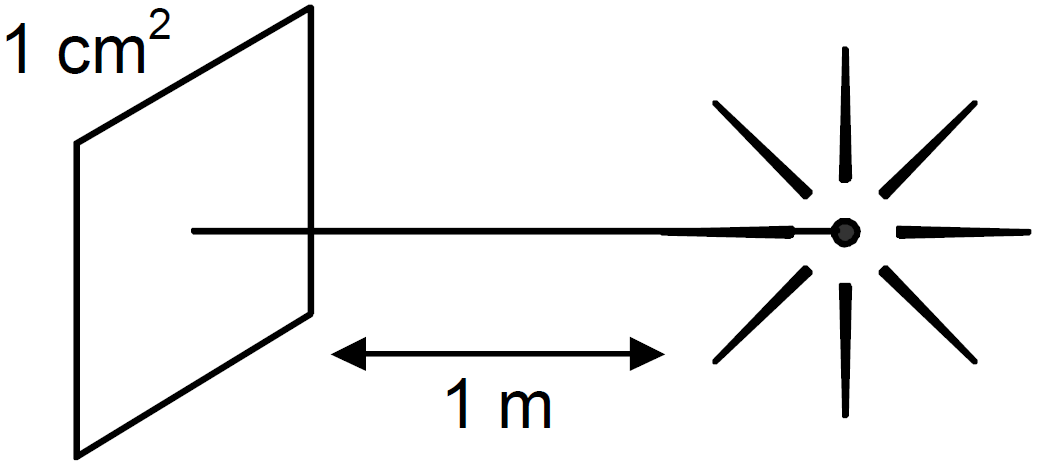
A point source emitting alpha particles is placed at a distance of 1m from a counter which records any alpha particle falling on its 1cm2 window. If the source contains 6.0 × 10¹⁶ active nuclei and the counter records a rate of 50000 counts/ second, find the decay constant. Assume that the source emits alpha particles uniformly in all directions and the alpha particles fall nearly normally on the window.
Answer

Counts received per cm2 = 50000 Counts/sec.
N = N3o of active nucleic = 6 × 10¹⁶
Total counts radiated from the source = Total surface area × 50000 counts/cm2
= 4 × 3.14 × 1 × 104 × 5 × 104 = 6.28 × 10⁹ $\text{Counts}=\frac{\text{dN}}{\text{dt}}$
We know, $\frac{\text{dN}}{\text{dt}}=\lambda\text{N}$
$\lambda=\frac{6.28\times10^9}{6\times10^{16}}=1.0467\times10^{-7}=1.05\times10^{-7}\text{s}^{-1}$

Need a full question paper?

Generate a complete, print-ready paper with questions like this in minutes — across 16+ boards, with answer keys.

Start Generating Free

Similar questions

Define the capacitance of a capacitor. Obtain an expression for the capacitance of a parallel plate capacitor. And explain on what factors the does capacitance depend?
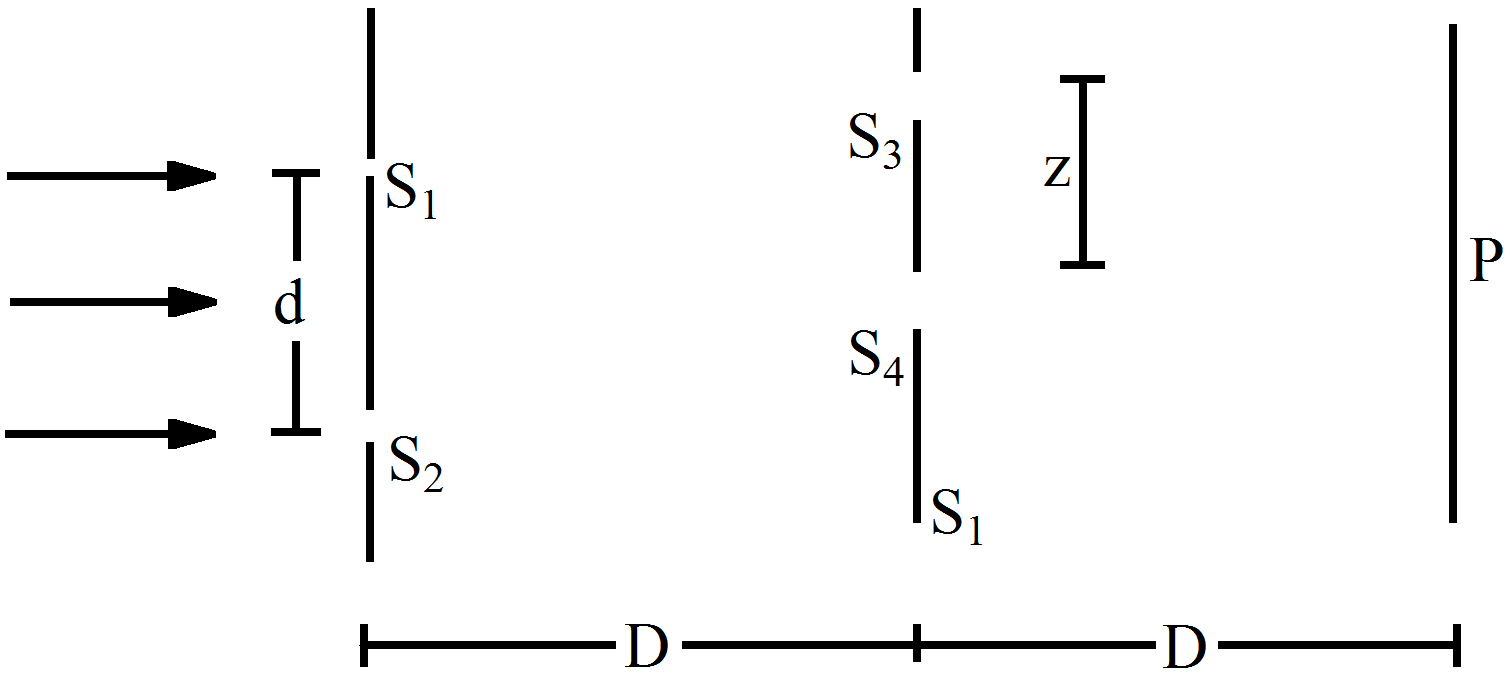
Consider the arrangement shown in figure. By some mechanism, the separation between the slits S3 and S4 can be changed. The intensity is measured at the point P which is at the common perpendicular bisector

of S1S2 and S3S4. When $\text{z}=\frac{\text{D}\lambda}{2\text{d}},$ intensity measured at P is I. Find this intensity when z is equal to:
  1. $\frac{\text{D}\lambda}{\text{d}}$
  2. $\frac{3\text{D}\lambda}{2\text{d}}$
  3. $\frac{2\text{D}\lambda}{\text{d}}$
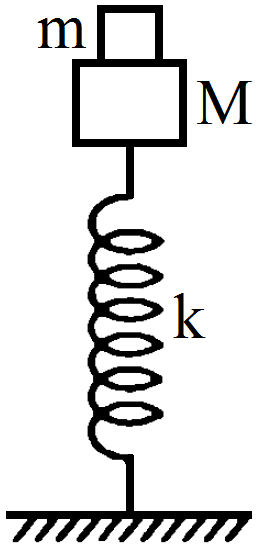
A small block of mass m is kept on a bigger block of mass M which is attached to a vertical spring of spring constant k as shown in the figure. The system oscillates vertically.
  1. Find the resultant force on the smaller block when it is displaced through a distance x above its equilibrium position.
  2. Find the normal force on the smaller block at this position. When is this force smallest in magnitude?
  3. What can be the maximum amplitude with which the two blocks may oscillate together?

The amount of charge that passes in time t through a cross-section of a wire is,
Q(t) = At2 + Bt + C.
  1. Write the dimensional formulae for A, B and C.
  2. If the numerical values of A, B and C are 5, 3 and 1, respectively, in S.I units, find the value of the current at t = 5s.
Use Moseley's law with b = 1 to find the frequency of the $\text{K}_\alpha$ X-ray of La(Z = 57) if the frequency of the $\text{K}_\alpha$ X-ray of Cu(Z = 29) is known to be 1.88 × 10¹⁸Hz.
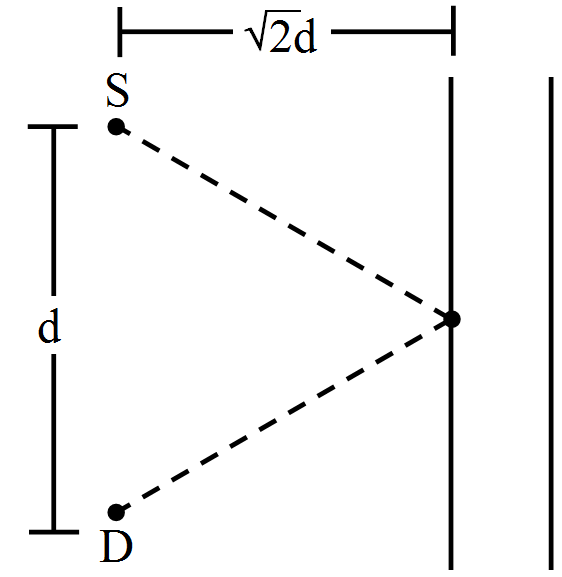
A source S and a detector D are placed at a distance d apart. A big cardboard is placed at a distance $\sqrt{2}\text{d}$ from the source and the detector as shown in figure, The source emits a wave of wavelength $=\frac{\text{d}}{2}$ which is received by the detector after reflection from the cardboard. It is found to be in phase with the direct wave received from the source. By what minimum distance should the cardboard be shifted away so that the reflected wave becomes out of phase with the direct wave?

A particle of mass 1g and charge 2.5 × 10-4C is released from rest in an electric field of 1.2 × 104NC-1.
  1. Find the electric force and the force of gravity acting on this particle. Can one of these forces be neglected in comparison with the other for approximate analysis?
  2. How long will it take for the particle to travel a distance of 40cm?
  3. What will be the speed of the particle after travelling this distance?
  4. How much is the work done by the electric force on the particle during this period?
Repeat the previous problem if the particle C is displaced through a distance x along the line AB.
Two masses m1 and m2 are connected by a spring of spring constant k and are placed on a frictionless horizontal surface. Initially the spring is stretched through a distance x0 when the system is released from rest. Find the distance moved by the two masses before they again come to rest.
What are coherent sources of light? Why are coherent sources required to produce interference of light? Give an example of interference in everyday life.