Question
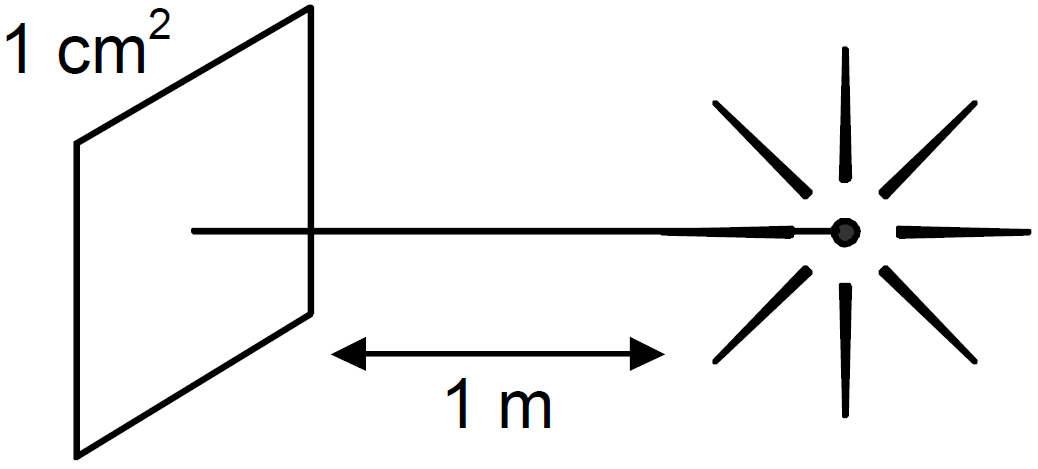
A point source emitting alpha particles is placed at a distance of 1m from a counter which records any alpha particle falling on its 1cm2 window. If the source contains 6.0 × 10¹⁶ active nuclei and the counter records a rate of 50000 counts/ second, find the decay constant. Assume that the source emits alpha particles uniformly in all directions and the alpha particles fall nearly normally on the window.
Answer

Counts received per cm2 = 50000 Counts/sec.

N = N3o of active nucleic = 6 × 10¹⁶

Total counts radiated from the source = Total surface area × 50000 counts/cm2

= 4 × 3.14 × 1 × 104 × 5 × 104 = 6.28 × 10⁹ $\text{Counts}=\frac{\text{dN}}{\text{dt}}$

We know, $\frac{\text{dN}}{\text{dt}}=\lambda\text{N}$

$\lambda=\frac{6.28\times10^9}{6\times10^{16}}=1.0467\times10^{-7}=1.05\times10^{-7}\text{s}^{-1}$

Need a full question paper?

Generate a complete, print-ready paper with questions like this in minutes — across 16+ boards, with answer keys.

Start Generating Free

Similar questions

A car weighs 1800kg. The distance between its front and back axles is 1.8m. Its centre of gravity is 1.05m behind the front axle. Determine the force exerted by the level ground on each front wheel and each back wheel.
Springs of spring constants k, 2k, 4k, 8k ............ are connected in series. A mass m kg is attached to the lower end of the last spring and the system is allowed to vibrate. What is the time period of oscillations? Given m = 40gm; k = 20Ncm-1
Explain why
A spinning cricket ball in air does not follow a parabolic trajectory.
A particle of mass m is kept on a fixed, smooth sphere of radius R at a position, where the radius through the particle makes an angle of 30° with the vertical. The particle is released from this position.
  1. What is the force exerted by the sphere on the particle just after the release?
  2. Find the distance travelled by the particle before it leaves contact with the sphere.
Define linear momentum. Prove that for fixed mass, $P \propto v$ and for constant momentum $v \propto \frac{1}{m}$.
Light is incident from glass $(\mu=1.50)$ to water $(\mu=1.33).$ Find the range of the angle of deviation for which there are two angles of incidence.
A projectile is fired horizontally with a velocity of $98 ms^{-1}$ from the hill 490 m high. Find
i. time taken to reach the ground
ii. the distance of the target from the hill and
iii. the velocity with which the projectile strikes the ground.
A baloon filled with helium rises against gravity increasing its potential energy. The speed of the baloon also increases as it rises. How do you reconcile this with the law of conservation of mechanical energy? You can neglect viscous drag of air and assume that density of air is constant.
A mica strip and a polysterene strip are fitted on the two slits of a double slit apparatus. The thickness of the strips is 0.50mm and the separation between the slits is 0.12cm. The refractive index of mica and polysterene are 1.58 and 1.55 respectively for the light of wavelength 590nm which is used in the experiment. The interference is observed on a screen a distance one meter away.
  1. What would be the fringe-width?
  2. At what distance from the centre will the first maximum be located?
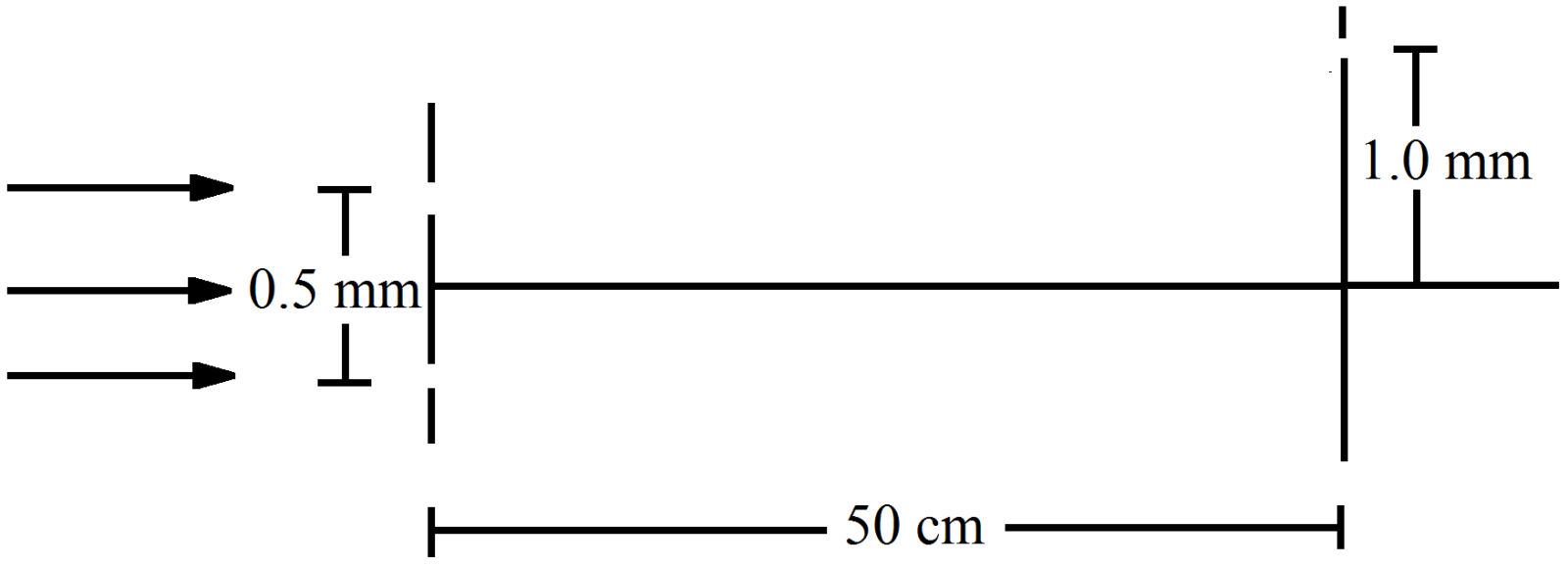
White coherent light (400nm - 700nm) is sent through the slits of a Young's double slit experiment (figure.) The separation between the slits is 0.5mm and the screen is 50cm away from the slits. There is a hole in the screen at a point 1.0mm away (along the width of the fringes) from the central line.
  1. Which wavelength (s) will be absent in the light coming from the hole?
  2. which wavelength (s) will have a strong intensity?